- Issued
- 11 November 2024
- Region
Black-throated finches are a small, seed-eating finch with a sleek, stocky appearance and a distinguishing large black throat patch that looks like a bib. There are two sub-species of black-throated finch. The southern sub-species, which can be found in grassy woodlands around Townsville, is endangered.
Once found from northern New South Wales to the Atherton Tablelands in Queensland, due to habitat loss, the southern sub-species of this finch is now found only in the northern part of its former range. Townsville is an important area for black-throated finches and the long-term survival of the southern sub-species is dependent on the Townsville population thriving.
In late 2019, an area of environmental offset land historically known as black-throated finch habitat, was gazetted as national park and turned over to QPWS Ranger Kenneth with the major focus being to manage the habitat for finches.
 Open larger image
Aerial view of the environmental offset land parcel that is now national park
Photo credit: P. Bourk © Queensland Government
‘When the land became national park and was handed over, it was very degraded with weeds, especially chinee apple (Ziziphus mauritiana), and the soil is what’s called sodic, so once you break through the surface topsoil it just erodes,’ Ranger Kenneth said.
‘My aim in the first 10 years was to get the area up to form, from a QPWS Rangers point of view, to be able to manage it as protected area. Tackle the erosion and weeds, get a fire management regime happening and harden the management tracks, because it’s a boggy area, all in the hope of encouraging black-throated finches to the area.
‘To do this, I first sat down with ecologists who were familiar with the habitat of black-throated finches and talked to people within the black-throated finch recovery team. Their knowledge and expertise, along with our QPWS natural resource management strategies, helped to develop the land management and monitoring practices we believed would work best for the preservation of this habitat.
‘Once I had a plan, I started targeting the weeds, getting rid of the chinee apple mature trees and the invasive guinea grass (Panicum maximum).
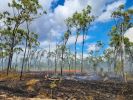
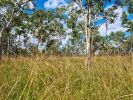
‘Introducing fire as a management tool was an important step. Utilising regular mosaic burning has seen a real positive change to the habitat, including more native grasses.’
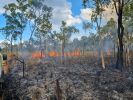
 Introducing fire as a management tool was an important step
Photo credit: K. McMahon © Queensland Government
Introducing fire as a management tool was an important step
Photo credit: K. McMahon © Queensland Government
 Utilising regular mosaic burning has seen a real positive change to the habitat
Photo credit: K. McMahon © Queensland Government
Utilising regular mosaic burning has seen a real positive change to the habitat
Photo credit: K. McMahon © Queensland Government
 More native grasses have been encouraging to grow in the popular gum woodland
Photo credit: K. McMahon © Queensland Government
More native grasses have been encouraging to grow in the popular gum woodland
Photo credit: K. McMahon © Queensland Government
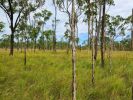
 Chinea apple weeds have been replaced by native grasses among the eucalypt and melaleuca woodland
Photo credit: K. McMahon © Queensland Government
Chinea apple weeds have been replaced by native grasses among the eucalypt and melaleuca woodland
Photo credit: K. McMahon © Queensland Government
‘What I’m working on now is raising and hardening our management tracks. This will provide the ability to get in and target weeds species that are currently inaccessible by vehicle when it’s wet and boggy. Timely targeting of weeds is important because many invasive grass species seed quickly,’ he said.
‘I’m also dealing with the challenge of managing illegal activities. Despite there being no public access to the area, so it can be restored and preserved as finch habitat, there are, unfortunately, people who illegally drive through to ‘practice’ their 4WD mud-driving skills. They go through, get bogged and really rip the area up.
‘There’s also been stolen cars abandoned and set on fire and other rubbish dumped too. It’s disappointing and can undo a lot of the hard work and progress that’s been made.’
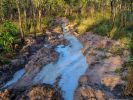
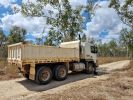


‘Rubbish is cleaned up as quickly as possible and targeted compliance is used to try and stamp out the illegal activities. There’s also fencing improvements I want to make. But a lot of the time it does come down to relying on people to help by doing the right thing and obeying our signs.
‘In the next 2 years I’m hoping all the management tracks will be sufficiently hardened and the fire breaks and fencing will all be up to a good standard. If the illegal activities can be stamped out, then it’s just a matter of maintaining the successful planned burns and weed management programs.’
Ranger Kenneth said getting ecologists, who are experts in their fields, to assist with evaluations has really helped.
‘They’ve worked with me to do weed mapping and fire recovery mapping. Providing invaluable data that allows for as-needed adjustments to be made to the management programs, like making sure planned burns are conducted at the best time of the year and under the best conditions for this habitat type,’ Ranger Kenneth said.
‘The ecologists have seen significant benefits that these management practices are having on the landscape.
‘It’s great to have it confirmed, that everything I’m doing is restoring and preserving the habitat. It’s really encouraging that black-throated finch surveys are showing that these fickle finches are definitely there, that they are using the habitat I’m working so hard to restore and protect!’
 Open larger image
Black-throated finches, as well as other species such as double-barred finches, have been surveyed in the national park
Photo credit: K. McMahon © Queensland Government
Ranger Kenneth has also been able to share his success and learnings with other neighbouring land managers.
‘Recently I’ve been able to share my learnings with the Townsville City Council, who’ve taken over the management of their own parcel of environmental offset land from the Haughton Pipeline Project,’ he said.
‘We met onsite and discussed the benefits of regular planned burns, effective treatment methods for eradicating weeds, current and upcoming research on black-throated finches, methods of erosion control and also managing illegal, destructive activities.
‘The councils’ parcel is close to ours, so we recognise the benefits for the local black-throated finch population of sharing successful habitat restoration and management knowledge.’
 Open larger image
Ranger Kenneth sharing his success and learnings with the Townsville City Council team
Photo credit: I. Summers © Townsville City Council
We are stronger together and all have a role we can play in the conservation of Queensland’s threatened creatures and their important habitats.
Related articles
-
Issued 6 November 2025
To keep your next travel plan in harmony with our feathered friends, we’ve put together a list of alternative locations you can visit within the…
-
Issued 12 February 2025
The Gudjuda team, consisting of five Rangers, worked diligently with NRM Ranger Charlie Finn to remove thousands of Siam weed plants from the day-use area…

