About Elizabeth Springs Conservation Park
Park features
Elizabeth Springs is a small 485hectare conservation park that protects rare mound discharge springs and the surrounding wetland habitat. The landscape is distinctive from the surrounding desert environment because of the permanent artesian mound springs.
Mineral-rich water from the Great Artesian Basin aquifer filters up to the surface through a geological fault in the overlaying rock. The artesian water is ancient, exposed to high pressure and hot temperatures deep within the aquifer, and can take more than a million years to discharge as a spring. Mounds are formed when wind-blown sand, mud and accumulated plant debris combines with the sediments and salts in the water as it evaporates. Mounds are shaped like small volcanos!
The springs are surrounded by fragile wetland vegetation that contains plants of significant conservation importance including a salt marsh pipewort and endemic aquatic herbs and grasses.
The springs are a vital source of water in this landscape. Their continuous trickle morphs the harsh cracked soil into green habitats that provide refuge for local wildlife. Because of the area’s remoteness, some species evolved in isolation and developed features unique to the Elizabeth Springs environment. Two species–the Elizabeth Springs goby and a freshwater hydrobiid snail–are not found anywhere else in the world.
Elizabeth Springs is the sole remaining Great Artesian Basin spring-complex of the otherwise extinct or heavily modified Springvale supergroup. Comprised solely of discharge springs the Springvale supergroup once contained 12 active spring-complexes covering about 8000 square kilometres. Elizabeth Springs is situated at the southern-most edge of the Springvale supergroup.
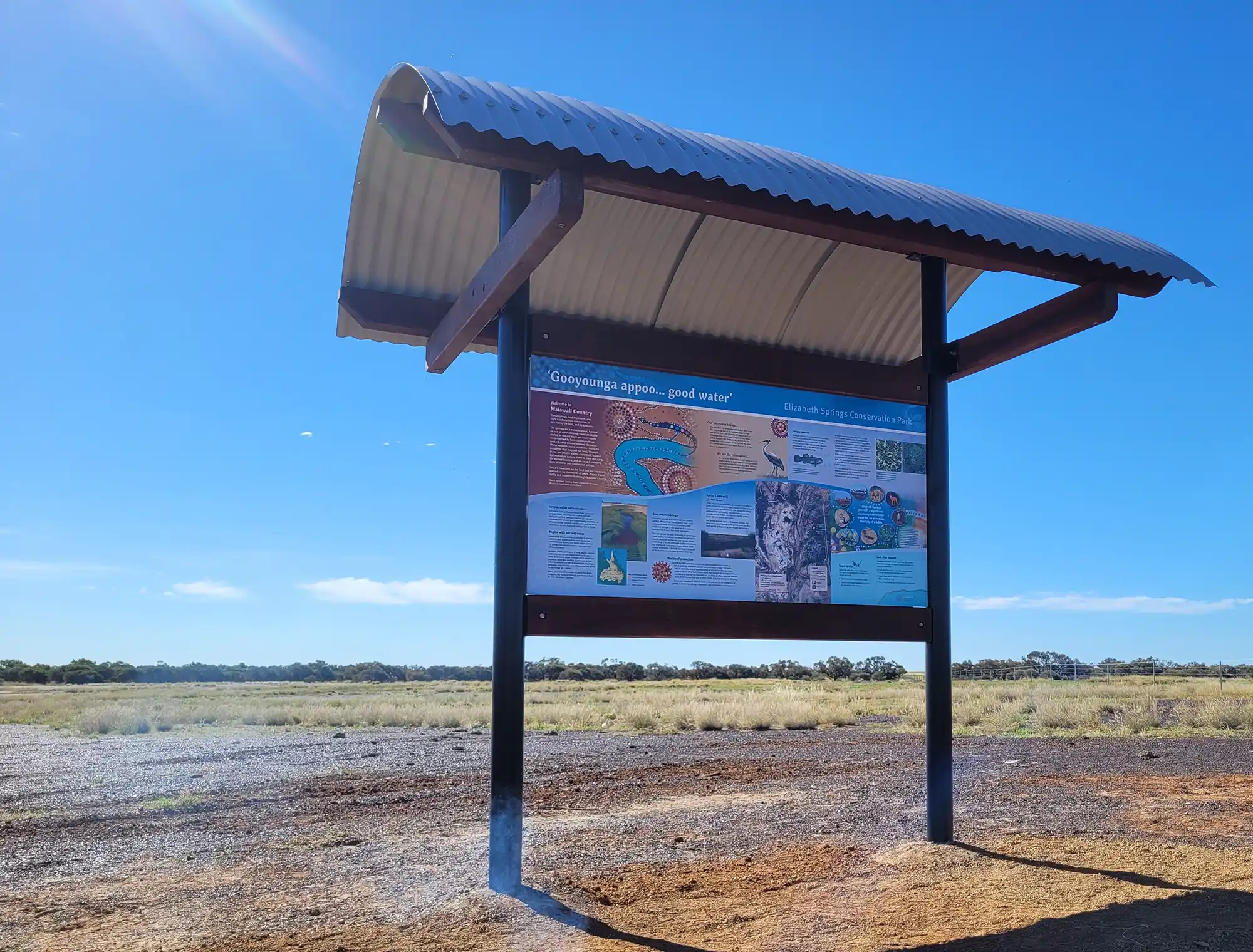 Open larger image
Learn about the conservation parks outstanding cultural and natural values.
Elizabeth Springs was gazetted as a conservation park in April 2000 to protect the rare mound springs and surrounding wetland habitat. The springs’ possess extraordinary natural and evolutionary qualities and are recognised as a place of outstanding national significance being inscribed on the National Heritage List in 2009.
This is Maiawali Country. The springs and surrounding wetlands are especially important to the Maiawali people, theirs is a deep-time connection to this water and the land.
Looking after the park
Everything in Elizabeth Springs Conservation Park is protected including the water, plants, animals, and cultural artefacts. Please appreciate, respect and help care for Elizabeth Springs’ outstanding natural and cultural values by leaving things as you find them, and encouraging others to do the same by following these guidelines.
- Stay on the marked walking track and don’t walk on the mound springs or nearby wetland vegetation. Many plants and animals in Elizabeth Springs are rare, threatened or endangered. Please do not disturb their unique habitat.
- Close the pedestrian entrance gate during and after your visit.
- Leave everything as you find it. Avoid disturbing the landscape, all animals and plants, and cultural artefacts.
- Stop the spread of weeds, insect pests and pathogens. New introductions can spread and displace resident species and alter the local ecology. Soil from your footwear and clothes can contain weed seeds, ants (and their eggs) and foreign plant pathogens. Before you arrive clean your footwear and walking gear. Follow the come clean, go clean guidelines learn more about pest plants and animals and pathogens.
- Manage your waste. Take your rubbish with you when you leave as no bins are provided. Secure rubbish in a sturdy rubbish bag in a sealable animal-proof container for disposal at off-park waste disposal facilities. Never bury rubbish as animals will dig it up.
- Toilets are not provided. Bury toilet waste (and paper) at least 15cm deep and 100m away from the walking track and creek.
- Keep food away from wildlife. Accidental or intentional feeding upsets the balance of nature and can make animals sick and/or aggressive. Never leave food or food scraps in the conservation park.
- Domestic animals are not permitted in the conservation park. Please observe the before you visit guidelines for dog and pets.
Please read looking after parks in Central West Queensland.
Park management
Each park in Central West Queensland has unique attributes. They are managed by Queensland Parks and Wildlife Service (QPWS) to conserve their natural condition and protect their cultural resources and values.
Tourism information links
Waltzing Matilda Centre
www.matildacentre.com.au
www.dinosaurtrackways.com.au
50 Elderslie Street, Winton
ph (07) 4657 1466 or 1300 665 115
email waltzing@matildacentre.com.au
Diamantina Shire Council
www.diamantina.qld.gov.au
www.thediamantina.com.au
17 Herbert Street, Bedourie
ph (07) 4746 1600
email admin@diamantina.qld.gov.au
For information on road conditions contact:
Queensland Transport
Phone 13 19 40 for 24-hour road reports.
For tourism information for all regions in Queensland see Queensland Holidays.
- There are currently no park alerts for this park.