Great Sandy Marine Park artificial reefs
The Queensland Government has established four artificial reefs located in accessible inshore locations within the Great Sandy Marine Park, making them very popular marine activity destinations, as well as one further afield towards the centre of Hervey Bay that provides a unique diving opportunity. Artificial reefs attract and sustain a wide diversity of marine life by providing protection from predators, shelter from ocean currents, breeding opportunities and a supply of rich food sources. The variety of habitats created by the Great Sandy Marine Park artificial reefs sustain a diversity of marine species.
A unique artificial reef for diving only – The ex-HMAS Tobruk
The dive-only ex-HMAS Tobruk artificial reef is located towards the middle of Hervey Bay and is a 127m former navy ship now home to a thriving ecosystem. The scuttling of the ex-HMAS Tobruk in 2018 created an artificial reef that has become an exceptional dive site in the marine park. The wreck is home to corals, molluscs, demersal and pelagic fish species, turtles, rays, sharks and more. The ex-HMAS Tobruk sits within a Marine National Park zone, prohibiting fishing. Entry to the designated area is prohibited without a permit or written approval. Find out more information on the ex-HMAS Tobruk.
Artificial reefs for fishing and diving within the Great Sandy Marine Park
Point Vernon Artificial Reef
Point Vernon Artificial Reef was installed in 2025 as part of a $2.5 million investment by the Queensland Government. Point Vernon Artificial Reef is located close to popular inshore fishing grounds just 1nm from Gatakers boat ramp in a depth of 6m-8m.
88 bombora reef structures have been placed in an intentional configuration to allow for habitat connectivity for the animals who will colonise this reef over time. The bombora modules encourage diversity and abundance in marine assemblage due to differing size voids able to be utilised by species of varying sizes and trophic levels creating a self-sustaining ecosystem.
Elliott Heads Artificial Reef
Elliott Heads Artificial Reef was also installed in 2025 as part of the $2.5million investment by the Queensland Government. This reef is located 0.5nm from four-mile reef, (a marine national park zone), off the coast of Elliott Heads, Bundaberg. In time, this artificial reef will support the region’s maritime activity lifestyle and promote regional economic growth on nature-based tourism.
Elliott Heads Artificial Reef is deployed in a configuration of three clusters of five reef pyramid structures in a depth of 11m – 13m.

The artificial reefs attract an abundance of marine life.
Photo credit: Queensland Government

Members of the recreational fishing community were involved in the planning process.
Photo credit: Queensland Government
Simpson Artificial Reef
Simpson Artificial Reef, established in 2015, is located near the Outer Banks, approximately 7nm from the Urangan Marina in Hervey Bay. It is named after Woody Island’s first head lighthouse keeper Mr John Simpson.
The reef consists of fifteen reef pyramid structures distributed over an 80ha area in five clusters of three, to a depth of 10-16m.
Hardie Artificial Reef
Hardie Artificial Reef, established in 2015, is located 2nm north-east of Little Woody Island. The artificial reef is named after Woody Island’s longest serving head lighthouse keeper, Mr Peter Hardie.
The reef consists of fifteen reef pyramid structures distributed over 160ha in five clusters of three, to a depth of 10–16m.
Creating a reef

A crane lowering artificial reef pyramid structures into position.
Photo credit: Queensland Government
Creating artificial reefs involves extensive research and planning, including mapping and analysis of physical, environmental, social and economic factors. Analysis informs decision making, including artificial reef location and material selection. Some of the factors considered included:
- aspirations and diversity of potential users
- historic use of potential sites, including recreational and commercial fishing, and diving
- cultural sites and sensitivities
- the desired marine species to be attracted
- proximity to natural reefs and declared marine national park (green) zones
- site conditions and characteristics, including wind, waves, tide, and water depth
- reef structure clearance
- accessibility of the site
- material characteristics, including design, size, weight, density and composition
- material life expectancy—minimum of 30 years
- ability to withstand significant weather events
- deployment constraints
- compliance with Australian standards and legislation
- safety considerations (during and after construction).
A team effort
- Construction of the reefs was a significant undertaking involving careful planning and development. Although the Queensland Parks and Wildlife Service (QPWS) was the lead agency responsible, working groups were established at the beginning of the projects to guide the development of the program. Working groups comprised representatives from recreational, charter and commercial fishing bodies, diving groups, the tourism industry, conservation groups, researchers, First Nations peoples, the Local Member of Parliament, QPWS and other government departments.
- Working groups provided advice on all major aspects of the program, including determining the purpose of the reefs, site selection, materials to be used, and ongoing management (including reef monitoring and enhancement).
The reef structures

Deployment of a pyramid reef structure.
Photo credit: Queensland Government
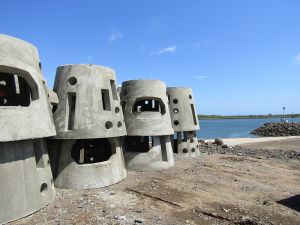
Bombora reef structures prior to barge loading for deployment at Point Vernon
Photo credit: Queensland Government
The pyramid reef structure is made of steel reinforced with concrete with a large internal volume of 80 cubic metres, measuring 4m x 4m x 5m and weighing 23 tonne. The combined modules form vertical relief and cellular spaces that create complex habitats and allow the reef structures to permanently recruit sustainable populations of target species, such as reef fish, pelagic fish and crustaceans.
The bombora reef structure is made of concrete with a diameter of 2.1m, a height of 1.8m and weighing 3.3 tonnes. One side of the bombora consists of multiple small holes 150mm in diameter, while the other side has a large hole of 500mm tall and 1000mm wide. This creates a shaded area with reduced current to promote growth on the internal faces and protect bottom-dwelling species.
Useful links
- Great Sandy Marine Park
- Maps and apps
- Entry and use provisions table
- Looking after Great Sandy Marine Park
- Department of Agriculture and Fisheries
More information
For more information on the artificial reef program, please contact the department.
- Ex HMAS Tobruk public mooring temporary closed 13 August to 30 September 2026
Get the app!
Zone and designated area information for the Great Sandy Marine Park and Moreton Bay Marine Park.
