Visiting Munga-Thirri safely
Getting there and getting around
Warning! Only well-equipped visitors experienced in desert and remote area travel should enter Munga-Thirri and the Simpson Desert. Isolation, hot weather, unexpected rain and potential vehicle breakdowns require that you plan well ahead for your visit.
Travel with another vehicle and be totally self-sufficient, prepared for all emergencies and well-equipped to cope with the harsh environment in Australia's driest place.
It is vitally important you read and follow the advice in before you visit and staying safe.
From Birdsville take the sealed road 35km west to Big Red sand dune at the edge of the Simpson Desert. From here on you must have a high clearance 4WD vehicle. Follow the signs at Big Red to the QAA Line. You must stay on the QAA Line.
Once inside Munga-Thirri National Park, the remaining 130km to Poeppel Corner traverses loose sand dunes and is impassable when wet. The one-way trip takes 5-6 hours so allow for an overnight stay.
Even small amounts of rain can make outback roads impassable, always be prepared and have at least 2 weeks’ worth of extra supplies in case of stranding.
Before your trip remember to:
- Check with the local council and Queensland Traffic for current road conditions.
- Check Park alerts for Munga-Thirri National Park for the latest information on access, closures and conditions.
- Check Bureau of Meteorology for the current weather and warnings. Even if there has been no local rain, flood waters can flow down watercourses from hundreds of miles away!
If you intend continuing beyond Queensland and into the South Australian part of the Simpson Desert, you will need to purchase a Desert Parks Pass.
If you intent continuing beyond Queensland and into the Northern Territory part of the Simpson Desert, you will need a permit from the Central Land Council. Visit clc.org.au for details.
To help you plan your visit to this remote area, simply download the Central West Queensland National Parks visitor guide .
Wheelchair accessibility
There are no wheelchair-accessible facilities in Munga-Thirri National Park.
Staying safe
Munga-Thirri National Park is very remote and help can be days away. It is critical that you are totally self-sufficient and prepared for all emergencies.
Before you leave
- Thoroughly check the condition of your vehicle and pack vehicle spares, recovery and repair equipment. Include 2 spare tyres, engine coolant and oil. Read 4WD with care for important information on 4WD safety and minimal impact driving.
- Choose your destination wisely! Make sure you are familiar with your equipment, vehicle and someone in your group has experience with remote area travel and inland Australian conditions. Ensure one person has sound mechanical knowledge of your vehicle.
- Expect rough, slow, dusty and/or boggy roads, far from help if something should go wrong. Check local road and weather conditions and extended weather forecasts for the locations you intend to visit.
- Plan to fuel up regularly. Calculate driving times and distances accurately and plan your refuelling points. Driving time on an unsealed road is much longer than on a bitumen road! Frequent low gear and 4WD travel will use more fuel too. Remember, national park bases and local properties are not service stations.
- Leave an itinerary with a friend or relative. Include travel routes and/or check-in points.
- Plan for emergencies. Pack reliable communication equipment, extra supplies and a list of local UHF radio channels and emergency contacts.
- Check current weather warning for Queensland. Flood waters can flow down watercourses from hundreds of miles away, even if the has been no local rain.
- Pack for hot and cold conditions (plus flies and midges!). Outback Queensland can be very hot during the day, and very cold (to below freezing point) overnight. Check with the Australian Bureau of Meteorology for more information on average temperatures.
- Seek local advice. Contact relevant tourist information centres to help plan your trip.
- Book your camp site. To camp in a national park, you must plan well ahead and obtain a camping permit and pay your camping fee before you arrive. Remember, mobile phone coverage is very limited in Central West Queensland national parks. Visit qld.gov.au/camping for detailed information on camping bookings and fees.
While visiting
- Keep to the QAA Line and drive with caution as conditions can change quickly. Watch out for animals, they can appear at any time of day though are generally more active at dusk and dawn.
- Always stay with your vehicle if it breaks down and wait for help to arrive. A vehicle is much easier to find than a person.
- Always carry drinking water, whether driving or walking. Boil, filter or treat water from streams, rivers or waterholes before drinking.
- Wear protective clothing. Put on a hat, sunscreen, insect repellent and wear sturdy footwear, not thongs.
- Be aware of your surroundings at all times and be on the lookout for animals and insects that could scratch, sting or bite.
- Travel with another vehicle and make sure someone reliable knows your itinerary.
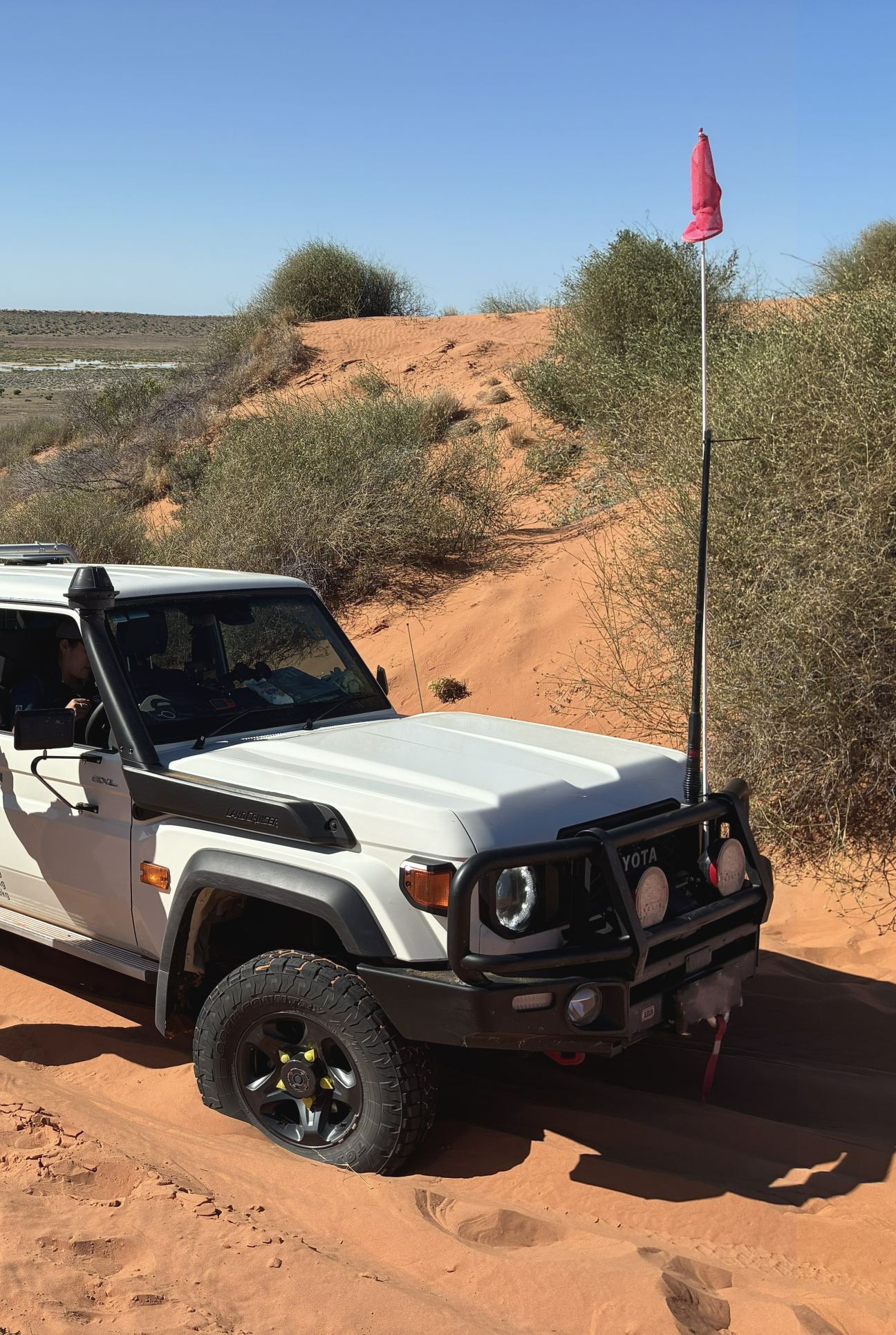 Open larger image
High clearance 4WD, recovery gear, communication equipment and a high visibility flag are essential for crossing the QAA Line.
Photo credit: © Queensland Government
Safe desert dune driving
- Vehicle tracks are high clearance 4WD only. Tracks are un-maintained.
- Attach a high visibility flag to the highest point of your vehicle, such as your radio aerial. The top of the flag must be a minimum 3.5m above the ground. The flag must be at least 300mm x 290mm in size and made of fluorescent materials, red-orange or lime-yellow in colour.
- Approach dune crests with caution. Always assume there is an oncoming vehicle.
- Call points markers are located at 5km intervals along the QAA line between Big Red and Poeppel Corner. At each marker alert other vehicles of your position and direction of travel on UHF channel 10. Keep radio chatter to a minimum. Example UHF channel 10 call - “QAA call point 1, two vehicles heading west”.
- Cross dunes carefully. Shifting sand creates steep drips, depressions and humps. Cross when the sand is cool, early morning or late afternoon is best.
- Stop driving if visibility is poor. Gusty winds create dust storms with little warning. Wait in your vehicle until conditions improve.
- Keep to the marked QAA Line track to avoid hazards. Saltpans may look solid but beneath their thin-loamy crust is soft, sticky black mud.
- Take care when altering tyre pressure. If you choose to reduce tyre pressure to improve traction in soft sand, check manufacturer's recommendations. Consider weight and load, reduce speed, avoid sudden turns and drive to suit conditions. Reinflate tyres immediately to manufacturer’s recommendations once conditions improve.
- Carry extra fuel, a second spare tyre and spare tubes. Driving in soft sand increases fuel consumption and punctures are highly likely.
For more information about safe sand driving, refer to four-wheel drive with care and the driving on sand guidelines.
For more safety information, please read the guidelines on safety in parks and forests.
In an emergency
In an emergency, phone Triple Zero (000). You could also try to make contact with other people on UHF radio (try channel 10 for other local radio traffic).
Mobile phone coverage is not available in the national park. Carry a satellite phone, UHF or HF radio, a personal locator beacon (PLB) is also advisable.
We highly recommend you visit the Triple Zero website before visiting a national park or forest. Download the Triple Zero emergency app to help identify your location. Important: if there is no mobile coverage on any network, you will not be able to reach the Emergency Call Service via a mobile phone.
Before you visit
Munga-Thirri and the Simpson Desert is vast and remote. Visitors must be experienced in remote area travel, completely self-sufficient and prepared for all emergencies.
Isolation, hot weather, unexpected rain and the potential for vehicle breakdowns require that you plan well ahead for your visit.
Remember! Travel in two-vehicle parties, stay on the QAA Line, and leave a copy of your travel plans with family or someone responsible before you leave home.
Essentials to bring
- Sufficient water, food and emergency supplies. Carry at least 7 litres of water per person per day (for drinking, cooking and limited washing) plus an extra 2 weeks' emergency supplies in case of stranding.
- Portable fuel stove (recommended) and/or your own clean milled firewood.
- Complete first-aid kit and medications. Include sun and insect protection in your kit.
- Reliable camping gear in good working order.
- Sturdy rubbish bags and sealable animal-proof containers.
- Communication equipment. UHF or HF and satellite phones are essential. Personal locator beacons (PLBs) are recommended. Mobile phone coverage is not available in Munga-Thirri National Park.
- Detailed road maps showing travel routes. A GPS may be useful.
- Extra fuel, vehicle repair equipment and spares. Frequent low gear and 4WD travel will use fuel more quickly. Additional spare tyres, oil and engine coolant, vehicle recovery gear and air compressor.
- Suitable clothing to cope with hot days and freezing nights in Australia’s driest place!
Opening hours
Munga-Thirri National Park is closed from 1 December to 15 March due to extreme summer temperatures that can exceed 50°C. Wet weather may cause temporary closures at other times. Check park alerts for Munga-Thirri National Park for information on park conditions, access and closures.
Permits and fees
Camping permits are required and fees apply.
- Book your camping permit online.
- If you cannot book online, see camping bookings for other options.
Various activities in national parks require a permit. Activities include commercial tours, social events, organised group visits, school excursions, scientific research, professional photography and the sale of photographs or vision of the park. Contact us for further information.
If you intend continuing beyond Queensland and into the South Australian part of the Simpson Desert, you will need to purchase a Desert Parks Pass. See the tourism information links for more information.
Pets
Dogs and other domestic animals are not permitted in Munga-Thirri National Park.
Climate and weather
Visiting is recommended from May to September as summer temperatures reach over 50°C and summer rains often cause flooding. You must be well equipped to cope with scorching days and freezing nights which can occur at any time—winter mornings can fall below freezing point.
Average annual rainfall is less than 150mm and typically occurs in short downpours from December to March, although rain can occur at any time of year causing temporary flooding and road closures. No permanent surface water occurs in the park, due to a parching evaporation rate. Dust storms are common in dry times.
Weather forecasts are available from the Bureau of Meteorology.
Fuel and supplies
The nearest fuel and supplies in Queensland are in Birdsville, 79km from the park entrance. If you are travelling interstate use maps to plan refuelling points and calculate how much extra fuel you must carry to reach them. Don’t forget frequent low gear and four-wheel-driving uses much more fuel.
- There are currently no park alerts for this park.