About Welford
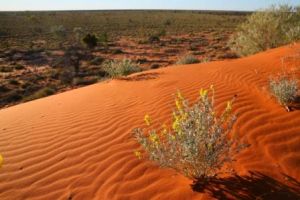
Welford National Park's popular Desert Drive.
Photo credit: John Augusteyn © Queensland Government
Park features
Welford is a land of contrasts—wide coolibah-lined waters and grey alluvial channels of the Barcoo River slice a brown and green swathe through Mitchell grass plains and arid mulga woodlands. Golden-green spinifex and white-barked ghost gums grow atop a vivid backdrop of red sand dunes.
Majestic river red gums line the Barcoo River, the southern boundary of the 124,000ha park. Varied habitats create vital refuges for wildlife, including mulga parrots and the vulnerable yellow-footed rock-wallaby.
First Nations people of the area have a long and ongoing connection to the land and waterways of the Barcoo River—the park contains places of significant cultural heritage. A former grazing property, the unique pisé (rammed earth) homestead built in 1882, is a feature in the park. The homestead is not open to the public.
Read more about the nature, culture and history of the parks of Central West Queensland
Looking after the park
Everything in Welford National Park is protected, including plants, animals, heritage sites and artefacts. Please appreciate, respect and help care for Welford’s outstanding natural and cultural values by leaving things as you find them, and encouraging others to do the same by following these guidelines.
- Leave everything as you find it. Avoid disturbing animals and plants, cultural artefacts and historical sites.
- Keep food away from wildlife. Accidental or intentional feeding upsets the balance of nature and can make animals sick and/or aggressive. Never leave food or food scraps around your camp sites or a day-use area.
- Manage your waste. Take rubbish with you when you leave as no bins are provided. Secure rubbish in a sturdy rubbish bag in a sealable animal-proof container for disposal at off-park waste disposal facilities. Never bury rubbish as animals will dig it up.
- Use toilets where provided. Where toilets are not available—bury toilet waste (and paper) at least 15cm deep and 100m away from camp sites, tracks and watercourses. Bag all personal hygiene products including disposable nappies and wipes for disposal off-park. Never pour portable toilet waste into parks’ toilets, our toilets cannot cope with the waste or chemicals. Empty chemical toilets at approved toilet waste disposal facilities in Windorah or Longreach (see Tourism information links).
- Never contaminate water. Wash yourself and utensils well away (at least 50m) from waterways. Do not use detergent, soap or shampoo in or near waterholes or the river.
- Bring your own clean firewood such as untreated, mill off-cuts. Collecting firewood in the national park is not permitted. Use the fire rings provided or preferably use a portable fuel stove.
- Stop the spread of weeds, insect pest and soil pathogens. New introductions can spread and displace resident species and alter the local ecology. Soil from your vehicle, camping gear and footwear can contain weed seeds, ants (and their eggs) and foreign plant pathogens. Before you arrive clean all vehicles (especially the tyres and undercarriage), all camping equipment and walking gear. If available, use a washdown facility provided in a local town. Follow the come clean, go clean guidelines.
- Don’t use firearms, chainsaws or unregistered vehicles in protected areas.
- Practise responsible fishing. Check your bait and comply with size and bag limits, see Department of Agriculture and Fisheries.
- Domestic animals are not permitted in the national park. Please observe the before you visit guidelines for dog and pets.
Please read looking after parks in Central West Queensland.
Park management
Each park in Central West Queensland has unique attributes. They are managed to conserve their natural condition and protect their cultural resources and values.
Tourism information links
Barcoo Shire Council
www.barcoo.qld.gov.au or www.visitbarcoo.com.au
6 Perkins Street, Jundah
ph (07) 4658 6900
email shire@barcoo.qld.gov.au or tourism@barcoo.qld.gov.au
Jundah Visitor Information Centre
www.barcoo.qld.gov.au or www.visitbarcoo.com.au
11 Dickson Street, Jundah
ph (07) 4658 6930
email jundahinfo@barcoo.qld.gov.au
Windorah Visitor Information Centre
www.barcoo.qld.gov.au or www.visitbarcoo.com.au
7 Maryborough Street, Windorah
ph (07) 4656 3063
email windorahinfo@barcoo.qld.gov.au
Longreach Regional Council
www.longreach.qld.gov.au
www.experiencelongreach.com.au
96 Eagle Street, Longreach
ph (07) 4658 4111
email council@longreach.qld.gov.au
For information on road conditions see Queensland Traffic.
Phone 13 19 40 for 24-hour road reports.
For tourism information for all regions in Queensland see Queensland Holidays.
- Temporary closure : Mulga Drive return loop on Welford National Park 21 July to 31 October 2026