Visiting Wiliyan-ngurru safely
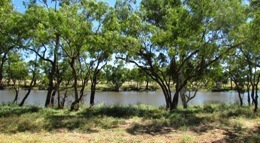
Picnic beside Nowranie Waterhole.
Photo credit: Gary Featonby © Queensland Government.
Getting there and getting around
At Camooweal, turn south at the Post Office Hotel onto Urandangi Road (Urandangi Road is sealed for the first 500m only). Travel for 15km, the turn-off to the national park is located on the left. From the turn-off, the Nowranie Waterhole day-use area is 6km and the Nowranie Caves car park is 8km.
Access is possible in dry weather with a 2WD driven with caution. 2WD vehicles may experience difficulties at creek crossings or on the rocky sections of the unsealed road. A 4WD vehicle is recommended. The road is not suitable for towing caravans.
Do not attempt to access the national park during or after wet weather as the unsealed (dirt) road becomes boggy and is impassable.
Before your trip, remember to:
- Check Queensland Traffic and Mount Isa City Council for current road conditions.
- Check Park alerts for Wiliyan-ngurru National Park for the latest information on access, closures and conditions.
- Check Bureau of Meteorology for current weather and warnings.
Wheelchair accessibility
There are no wheelchair-accessible tracks or facilities in the park.
Staying safe
Wiliyan-ngurru is semi-remote and rangers may not be onsite to help you. You must be self-sufficient, responsible for your own safety and prepared for all emergencies.
Wiliyan-ngurru National Park is semi-remote and rangers may not be onsite to help you. Hot weather, unexpected rain and potential vehicle breakdowns require that you plan well ahead of your visit. You must be self-sufficient, responsible for your own safety and prepared for all emergencies.
Be sure to read essentials to bring and follow the guidelines below to help make your visit a safe and enjoyable.
Before you leave
- Plan for emergencies. Carry adequate food, drinking water, a first-aid equipment, fuel and basic vehicle repair equipment in case of unexpected delays or breakdown.
- Pack at least one form of communication equipment. Satellite phones and Personal Locator Beacons (PLBs) are the most effective in this area. Mobile phone coverage is unreliable.
- Leave an itinerary with a friend or relative. Include travel routes and/or check-in points.
- Check current weather warning for Queensland. Flood waters can flow down watercourses from hundreds of kilometres away, even if there has been no local rain.
- Pack for hot and cold conditions (plus flies and midges!). Outback Queensland can be very hot during the day, and very cold overnight.
- Seek local advice. Contact relevant tourist information centres to help plan your trip.
While visiting
- Keep to designated roads and tracks. Drive with caution as road conditions can change quickly. Watch out for animals, they can appear on roads at any time of day, though are more active at dusk and dawn.
- Stay with your vehicle if it breaks down. A vehicle is much easier to find than a person.
- Carry and drink enough water. Filter or treat water from streams, rivers or waterholes before drinking.
- Never jump or dive into water. It may be shallow or hide submerged objects.
- Stay away from the edges of sinkholes. The sinkhole entrances are unstable due to natural weathering. Heed all safety advice and warnings and supervise your children closely.
- Watch your step. Take care on loose and uneven surfaces.
- Wear protective clothing. Put on a hat, sunscreen, insect repellent and wear sturdy footwear, not thongs.
- Always be aware of your surroundings. Lookout for animals and insects that could scratch, sting or bite.
For more information, please read the guidelines on safety in parks and forests.
In an emergency
For all emergencies call Triple Zero (000).
Satellite phones and Personal Locator Beacons (PLBs) are the most effective in this area. Mobile phone coverage is unreliable.
We highly recommend you visit the Triple Zero website before visiting a national park or forest. Download the Triple Zero emergency app to help identify your location. Important: if there is no mobile coverage on any network, you will not be able to reach the Emergency Call Service via a mobile phone.
Before you visit
Essentials to bring
To enjoy your time at Wiliyan-ngurru National Park remember to bring:
- a first-aid kit and reliable communication equipment
- fresh water for drinking
- a hat, sunscreen and sunglasses
- rubbish bags.
Opening hours
Wiliyan-ngurru National Park is open all year round. The national park may be closed at times due to wet conditions, severe weather or management operations. Check park alerts for the latest information on national park access, closures and conditions.
Permits and fees
Various activities in Queensland parks and forests require a permit. Activities include commercial tours, social events, organised group visits, school excursions, scientific research, professional photography and the sale of photographs or vision of the park. See Permits and fees for further information.
Pets
Domestic animals are not permitted in Wiliyan-ngurru National Park.
Climate and weather
This area has distinct wet and dry seasons, with unpredictable monsoonal rains falling between October and April. From May to September, it is cooler and drier, making this the best time to visit the national park. South-easterly winds at this time of the year help to make conditions more hospitable. Temperatures can be extremely high for the rest of the year, regularly exceeding 40 C in the summer. Weather forecasts are available from the Bureau of Meteorology.
Fuel and supplies
Fuel and supplies can be purchased 15km north of the national park at Camooweal or 189km south-east at Mount Isa. For more information, see the tourism information links.
- There are currently no park alerts for this park.