Things to do
Enjoy birdwatching, bushwalking, scenic driving, exploring historical sites and watching wildlife.
Camping and accommodation
Camping is permitted at Monks Tank camping area. A toilet (non-flush) is the only facility provided. Camping permits are required and fees apply.
- Find out more about camping in Idalia National Park.
- Book your campsite online.
- If you cannot book online, see camping bookings for other options.
- See more general information about camping in national parks.
Walking
Walk through the rugged, rocky gorges and tablelands at different times of day to discover Idalia at its best. You could easily spend a couple of days exploring Idalia’s most accessible spots. To help you plan your visit to Idalia, download the Parks of the Cooper Creek Catchment map (PDF, 134.0KB).
Watch your step on the escarpments! Edges can be unstable due to natural weathering. Stay away from edges and be mindful where you walk. Take heed of all safety advice and warnings.
Remember to follow the Parks and forests walk with care guidelines when out exploring the park. Wear sun protection, sturdy shoes and carry (and drink) plenty of water.
Old Idalia (Allow 30–45mins to explore)
Old Idalia is the site of a musterer’s hut and stockyards dating from the 1920s. Wander through the remains of a musterers’ hut, pass a wagon and see the old ship’s tank where a natural spring once supplied water to stock. Please leave everything at this historic site as you find it.
How to get there: Old Idalia is a 10km drive (one way) southeast of Monks Tank camping area.
Wave Rock walk—1.2km return (Allow 1–2hrs)
From Old Idalia, walk past the old ship’s tank then hike up to the wave-shaped cliff overhang known as Wave Rock. Wind, sun and time are nature’s carving tool here and sunset is the paintbrush.
Rainbow Gorge walk—200m return (Allow 30–45mins to explore)
Take a short walk 100m downstream to see a mass of white, red and yellow-tinted sandstone. The creek here drains into the Barcoo River via Thornleigh Creek.
How to get there: The entrance to Rainbow Gorge walk is a 4km drive (one way) north of Monks Tank camping area.
Bullock Gorge walk—2.7km return (Allow 1–2hrs)
Symbols on rocks (rock markers) show the way along the Gowan Range’s ridge top through bendee shrubland. Watch the sun rise or set over spectacular gorges and look for yellow-footed rock-wallabies. While sitting, you have a wallaby’s eye view of the herbs they seek among the tree trunks of the forest. Remember, bring a torch for sunset walks and take care where you walk as there are steep gorges on either side of the ridge.
How to get there: The trailhead of Bullock Gorge walk is a 14.7km drive (one way) north of Monks Tank camping area.
Emmet Pocket walk—4.4km return (Allow 2–3hrs)
From Emmet Pocket lookout a steep meandering track leads into a gorge where the plains of the outback spread out before you like a map. Trees mark the waterways that stretch from rocks to river channels.
How to get there: The trailhead of Emmet Pocket walk is a 12.1km drive (one way) northeast of Monks Tank camping area.
Driving
Discover Idalia’s history, wildlife and colour at its best on several short drives starting from Monks Tank camping area. Remember to bring extra fuel, practise low impact driving and follow the Parks and forests 4WD with care guidelines.
Murphys Rockhole—9.2km one way
Drive through thick, mature mulga to see a gorge shaded by large river red gums that begins abruptly in the sandstone. Remember to pack the binoculars and camera as Murphys Rockhole is a great for wildlife viewing.
Emmet Pocket lookout—12.1km one way
Catch stunning panoramic views over the park’s northern boundary from the lookout. If you are very quiet you may be lucky enough to see yellow-footed rock-wallabies hiding among the rocks below. Please do not disturb them by climbing down among the rocks.
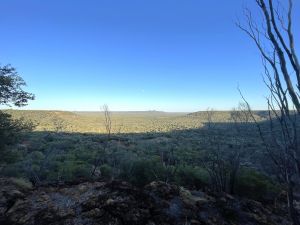
Panoramic views are on offer at Idalia National Park.
Photo credit: Janie White © Queensland Government
Viewing wildlife
Animals
Idalia is home to seven species of macropods. Wallaroos, red and grey kangaroos, swamp wallabies, black-striped wallabies and yellow-footed rock-wallabies.
Red and grey kangaroos graze on open plains while yellow-footed rock-wallabies inhabit high rocky escarpments. These animals are well camouflaged and leave the sanctuary of their rocky homes only to drink and graze at the base of the cliffs. The yellow-footed rock-wallaby is vulnerable to extinction. Their main threats include predation by foxes and dingoes, as well as competition from introduced herbivores such as feral goats and sheep.
Heavy-set common wallaroos forage on grassy slopes of the ranges or along creek beds for herbs and grasses. Swamp wallabies also chew herbs and grasses along creek beds.
Here, you may also see tiny kultarrs bounding gracefully in search of cockroaches and other bugs.
Black-striped wallabies are often seen nibbling short grasses.
A number of bird species observed at Idalia are at the known limits of their distribution. These include plum-headed finches, eastern yellow robins and speckled warblers. Colourful mallee ringnecks and mulga parrots, crested bellbirds, grey-crowned and Hall’s babblers and common bronzewing pigeons are often seen.
Plants
The Gowan Range’s steep escarpments lie along the edge of flat-topped peaks and tablelands. Mountain yapunyah, Dawson gum and lancewood are sometimes associated with the low bendee woodlands covering the escarpments and steep slopes. Bastard mulga is found on the stony flat-topped peaks.
Mulga covers most of Idalia. Areas of mature mulga scrub have a good cover of leaf litter and fallen logs, which make ideal fauna habitat. Ironwood, beefwood and sometimes turpentine mulga are found in the mulga communities on sandy soils.
On sandy flats beside the Bulloo River, open woodlands of poplar box (normally found in greater numbers further east) or silver-leaved ironbark occur. These have an understorey of wilga and eastern dead finish.
Stands of brigalow, boree and gidgee occur on areas of wooded downs, which are also contained in the park.
Fifteen native fuschia species have been found at Idalia. These shrubs have characteristic tubular flowers.
- Species lists are available from the Queensland Government's request a species list page.
- There are currently no park alerts for this park.