ANZAC connection—South East Queensland’s coastal and island parks
Issued: 22 Apr 2025
Discover the stories behind our military history preserved in South East Queensland’s coastal and island parks. See remnants and reminders of once-thriving bases for military defence and troop training, marvel at the grit and tenacity shown in the defence of our nation and pause to recognise the sacrifices made.
- Issued
- 22 April 2025
- Region
Fort Lytton—defending Queensland’s capital
Fort Lytton was built in 1880–81 to protect Brisbane from enemy attack, it’s the principal remaining landmark of a reserve that, until the end of World War II (WWII), was Brisbane's front line of defence.
At the time the fort was built, Brisbane had fewer than 100,000 people but produced an annual trade worth more than 4 million pounds.
As part of the British Empire, the Australian colonies were potential targets for rival empires and Queenslanders feared that Brisbane was more vulnerable to naval attack than Sydney or Melbourne as it was just 3 days' sail from the French naval garrison at Noumea.
Local defences were deemed essential so, the fort—a pentagonal fortress with heavy armaments concealed behind grassy ramparts—was built near the mouth of the Brisbane River.
It was designed to support the controlled river mines and counter any efforts made by enemy ships to attack Queensland’s capital and wealthiest port.
From the very start, Fort Lytton was the main training ground for the Queensland Defence Force and annual training camps became a highlight in Queensland's political and social calendar.
Every year, Brisbane's citizens would travel by train or boat to Lytton to watch the spectacle of military manoeuvres and ceremonial displays.
The first contingent to the Boer War trained at Lytton; and it remained an important training ground for Queenslanders who volunteered for the First Australian Imperial Force (AIF) in WWI.
By the outbreak of WWII, Fort Lytton was playing a secondary role to the modern facility of Fort Cowan Cowan on Mulgumpin (Moreton Island).
But with the escalation of hostilities, in 1942 the fort came into its own again, operating a boom gate that was the main defence for the Brisbane River.
It also ramped up its standing as a major training facility for a broad range of army, air force and naval personnel, which included the women’s services for the first time.
Fort Lytton became a national park in 1988 and today it’s dedicated to preserving the heritage site for future generations, telling its story through diverse and dynamic interpretation.
‘Visitors can really immerse themselves in history here. They can enjoy guided tours and re-enactments, Go Back in Time on a school holiday program for the whole family or attend a unique promenade theatre performance at night,’ Fort Lytton Ranger in Charge Michael said.
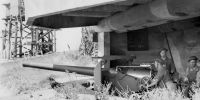
 Gun crew standing by their 4.7inch QF Mark IV naval gun in 1943.
Photo credit: © Australian War Memorial
Gun crew standing by their 4.7inch QF Mark IV naval gun in 1943.
Photo credit: © Australian War Memorial
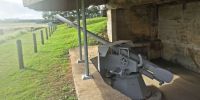
 Naval gun relic at Fort Lytton National Park.
Photo credit: © Helen Watt
Naval gun relic at Fort Lytton National Park.
Photo credit: © Helen Watt
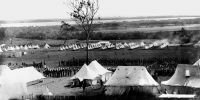
 Aerial view of the military camp at Fort Lytton.
Photo credit: © State Library of Queensland
Aerial view of the military camp at Fort Lytton.
Photo credit: © State Library of Queensland
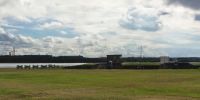
 Fortifications remaining at Fort Lytton National Park on the banks of the Brisbane River.
Photo credit: © Helen Watt
Fortifications remaining at Fort Lytton National Park on the banks of the Brisbane River.
Photo credit: © Helen Watt
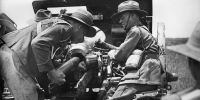
 Loading an artillery gun at Fort Lytton in 1933.
Photo credit: © State Library of Queensland
Loading an artillery gun at Fort Lytton in 1933.
Photo credit: © State Library of Queensland
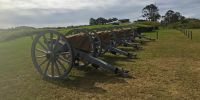
 Artillery guns at Fort Lytton National Park.
Photo credit: © Helen Watt
Artillery guns at Fort Lytton National Park.
Photo credit: © Helen Watt
Bribie Island—vital to Brisbane’s defence
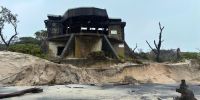
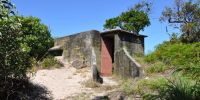
Scattered among the sand dunes of Ocean Beach on Bribie Island National Park, you’ll find weathered gun emplacements and searchlight buildings.
Constructed in 1939, the buildings are characteristic of the 6-inch gun batteries used to defend Brisbane and Queensland's coastline during WWII.
Fort Bribie was strategically located near the island's northern tip to secure the passage south.
The shallow waters of Moreton Bay are scattered with small islands, banks and sandbars, so large ships are limited to the main North West shipping channel that runs close to Bribie Island.
Guarding this important channel was vital to the defence of Brisbane during WWII. To further increase the defence capabilities of the island, a Skirmish 6-inch battery was also established at Skirmish Point in 1942.
According to Local Ranger Leanne, visitors can walk in from the beach to discover these hidden relics.
‘A walking track behind the dunes from the southern water tank links the WWII relics. Follow in the footsteps of the men and women that defended our coastline and get a glimpse into life during the war,’ Ranger Leanne said.
‘Be aware that shifting sand has left many of the structures exposed on the beach, and severe weather has reduced their stability. The battery at Skirmish has been mostly lost to erosion.
‘For your safety, admire the structures from a distance, stay behind the barriers, and don’t climb on the unstable ruins.’


Mulgumpin (Moreton Island)—defending the coast
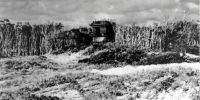
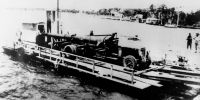
Mulgumpin (Moreton Island) also housed major coastal defence bases during both world wars.
In WWI, Fort Cowan Cowan was the island’s main defence base, although natural sand movement means very little of the base is visible today.
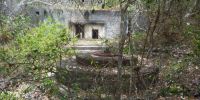
WWII saw 2 large defence battery-complexes built—one at Cowan Cowan as well as the Rous Battery at Toompani Beach.
Ranger in Charge Dean said visitors can check out some of the remnants of the Rous Battery left on the island.
‘When visiting Gheebulum Kunungai (Moreton Island) National Park, wander along the road built by the Civil Construction Corps during WWII on the Rous Battery track and imagine a time when this track was used to move troops, supplies and heavy guns,’ he said.
‘Make sure you venture down one of the smaller trails branching off the main track to the Rous Battery buildings, perched on the dunes.’


Learn more
If these connections make you an aspiring military history buff then you might like to find out more about Queensland’s parks and forests military history sites.
Related articles
-
Issued 19 June 2026
To implement planned burns effectively in diverse environments, QPWS uses aerial ignition to reach large or inaccessible areas at optimal times for burning.
-
Issued 17 February 2026
From real-time heat mapping to safer decision-making, this technology is transforming fire management.
-
Issued 4 August 2025
Look no further than our Junior Ranger programs to inspire your conservation-minded child.