About Cape Pallarenda
Park features
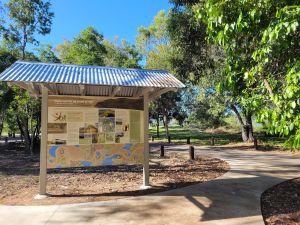
Information display, Cape Pallarenda day use area
Photo credit: © Queensland Government
Set in a landscape of open woodland and rocky shores, Cape Pallarenda Conservation Park protects a variety of animal and plant life and is a gateway to the recreational Cape Pallarenda trails.
Located on a rise behind the coastal sand dunes in the conservation park is the Queensland heritage listed Cape Pallarenda Quarantine Station—established in 1915, to quarantine passengers on incoming ships from the Asia/Pacific route. During World War II the American and Australian armies used this area. Cape Pallarenda Battery was built in 1943 to defend Townsville and the surrounding harbour. Camps were set up on nearby beaches, and the Quarantine Station was used as a hospital.
Visitors can learn more about the Quarantine Station history on information displays in the day-use area and wander around the World War II fortifications on the Cape Pallarenda headland. Access is not permitted to the Quarantine Station buildings.
Learn more about the natural, cultural and historical significance of Cape Pallarenda.
Looking after the park
- Respect First Nation peoples culture. Wariganda (Cape Pallarenda) represents thousands of years of living culture of special significance to the Gurambilbarra Wulgurukaba people. This landscape is easily damaged and irreplaceable. We ask that you travel lightly through Country.
- Respect Queensland heritage sites of significance. Cape Pallarenda Quarantine Station and the WWII fortifications are listed on the Queensland heritage register as sites reminiscent of Queensland’s recent past. Please do not damage or deface the sites.
- Stay on marked trails and formed roads. Do not short cut or form new trails as this will cause erosion and damage the environment.
- Keep the trails in good condition and limit erosion by not riding during or immediately after wet weather.
- Please take your rubbish with you. Rubbish bins are not provided in the conservation park.
- Leave your pets at home. Dogs and other domestic animals are not permitted. Please observe the before you visit guidelines for dogs and pets.
- Protect the wildlife. Please do not feed or leave food for animals, human food can harm wildlife and cause some to become aggressive.
- Stop the spread of weeds, insect pests and soil pathogens. New introductions can spread and displace resident species and alter the local ecology. Soil from your shoes, clothes, bicycles and vehicles can contain weed seeds, ants (and their eggs) and foreign plant pathogens. Before you arrive, check and clean your walking gear, bicycles and vehicle (especially the tyres). If available, use a washdown facility provided in town. Follow the come clean, go clean guidelines, and learn more about pest plants and animals and pathogens.
- Toilets are not provided. Bury all faecal matter and toilet paper at least 15cm deep and at least 100m away from the trails, heritage sites and the water. The closest toilet facilities are available at Freemasons Pallarenda Park, 500m from the conservation park entrance on the Cape Pallarenda Road.
- Do not enter the RAAF Radar Station which shares a boundary with the conservation park.
See the guidelines on caring for parks for more information about protecting our environment and heritage in parks.
Park management
In 1986, 44 hectares of land encompassing the former quarantine station was gazetted as an environmental park managed by Queensland Parks and Wildlife Service (QPWS). In 1990 and 1991, the remaining buildings were restored and became the then Regional Office of the department. It was gazetted as conservation park in 1994. As Queensland heritage listed buildings and structures, their protection is ensured into the future.
QPWS manages Cape Pallarenda Conservation Park for its natural and cultural values.
Tourism information links
Townsville Visitor Information Centre
www.townsvillenorthqueensland.com.au
Bulletin Square, 340 Flinders Street, Townsville QLD 4810
ph: (07) 4721 3660
email: hello@townsvillenorthqueensland.com.au
For tourism information on all regions in Queensland visit Queensland.com
-
The natural, cultural and historical significance of Cape Pallarenda
- There are currently no park alerts for this park.