Nature, culture and history
We recognise the traditional custodians of the Peak Range area – the Clermont-Belyando, Barada Kabalbara Yetimarala and Western Kangoulu people and pay our respects to Elders past and present.
A captivating landscape
The Peak Range landscape is part of an extensive continental volcanic province in Central Queensland, covering about 23,000 square kilometres. Formed between 32 and 29 million years ago, during the Tertiary period, the range divides the Fitzroy River drainage basin – separating tributaries of the Isaac River from tributaries of the Nogoa and Mackenzie rivers.
Three distinct divisions of the range are apparent – the peaks in the north, such as Gemini Mountains and Wolfang Peak, and the southern parts which generally consist of closely-spaced pinnacles or dome-shaped rocky protrusions. These impressive groups of sharp peaks rise dramatically from the surrounding, mostly flat, countryside. By contrast, in the central part of the range, prominent and picturesque flat-topped mesas and ridges such as Lords Table Mountain stand out in the landscape. These fascinating volcanic formations are formed from various combinations of basalt, rhyolite and trachyte.
Learn more about the Geology of The Peak Range .
Abundant diversity
The distribution of volcanics and their relationship to the watershed has resulted in eight different regional vegetation communities being represented in the 2,500ha Peak Range National Park. Four are ‘of concern’ and one is endangered, and one is endemic (occurring nowhere else) to the plateau of Lords Table Mountain.
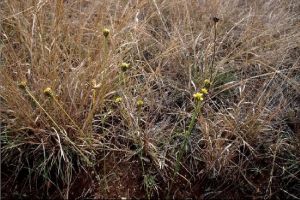
The small delicate yellow flowers of the endangered Trioncinia retroflexa
Photo credit: © Queensland Government
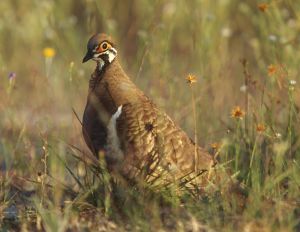
The squatter pigeon, when disturbed, tends to run or freeze in a squat. Perhaps how it got its common name!
Photo credit: John Augusteyn © Queensland Government
Peak Range National Park is representative of 2 ‘of concern’ regional ecosystems, the extent of which is restricted entirely to the plateau surface of Lords Table Mountain. The regional ecosystem support Themeda triandra grassland and Eucalyptus microcarpa and E. exserta low forest on Cainozoic igneous rocks (trachyte). The trachytic lava cap provides a hard surface that is resistant to weathering and ground damage or modification.
Areas of botanically rich semi-evergreen vine thicket grow on the steep rocky volcanic slopes of Lords Table Mountain. Coolibah woodlands occur on the alluvial plains within the national park, while brigalow and yellow-wood woodlands are established on the flat clay plains. Once growing extensively in Central Queensland, the national park supports brigalow communities which elsewhere have been cleared for cropping and pasture. The endangered king blue grass Dichanthium queenslandicum and the perennial herb Trioncinia retroflexa, with its small yellow flowers, are also found in the national park.
The national park’s range of habitats support a variety of wildlife, especially birds—download a species list. Listen out for spiny-cheeked honeyeaters and little friarbirds when the eucalypts and wattles are in flower. Look high for wedge-tailed eagles as they soar above the grassy open woodlands and peregrine falcons as they leave secluded cliff-face roosts to hunt.
Keep an eye out for the vulnerable southern squatter pigeon Geophaps scripta scripta feeding on the seeds of grasses, herbs and shrubs. Populations of this ground-dwelling bird are in decline in Queensland, due to habitat loss, fragmentation and predation by feral animals.
European history
Ludwig Leichhardt was the first recorded European to sight Peak Range on 18 January 1845, naming many of the peaks after participants and supporters of his overland venture from Moreton Bay to Port Essington. Survey markers exist on Wolfang Peak and Gemini Mountains denoting this expedition. Visit the Clermont Museum and Visitor Information Centre, located on the Peaks Down Highway, to learn more about the region’s vibrant history. Find out more, including opening hours, on the Issaac Regional Council’s website.
- There are currently no park alerts for this park.