Boat strike impact on turtle and dugong in Moreton Bay
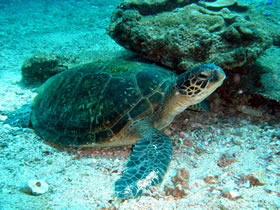
Healthy green turtle
Moreton Bay Marine Park is one of Queensland’s most important natural, recreational, cultural and economic resources. With south-east Queensland growing faster than any other region in Australia, the popularity of the marine park for boating and fishing is rapidly increasing.
Moreton Bay Marine Park, which was declared in 1993, stretches along 125 km of coastline from Caloundra to the Gold Coast Seaway and is managed by the Queensland Parks and Wildlife Service (QPWS). The marine park aims to maintain a balance between the needs of the bay and those who use it, now and for the future.
Years of research and observation of turtles and dugong in Moreton Bay has found that it is an important feeding area and one of the only places in the world where turtles and dugong still live on the doorstep of a major city.
- Read more about turtles in Moreton Bay Marine Park
- Read more about dugongs in Moreton Bay Marine Park
Boat strike threat
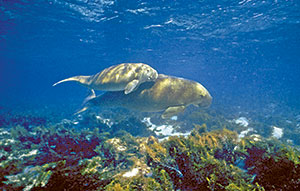
Dugong and calf.
Photo credit: © Queensland Government
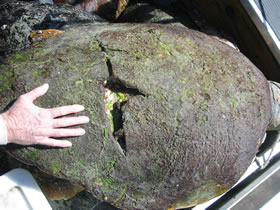
Boat strike victim 22/4/06
Turtle and dugong are surface-breathing marine animals and are often injured or killed by speeding vessels when coming up for air. Unfortunately, Moreton Bay is a hot spot for boat strikes— each year around 250-300 reports of sick, injured and dead turtles in Moreton Bay are received by QPWS. Moreton Bay sees more marine animal strandings than any other region in Queensland.
In the marine park, there are two types of turtle and dugong go slow areas. One requires all vessels, including jet skis, to be operated off-the-plane or in displacement mode and prohibits motorised water sports. There are six of these designated turtle and dugong 'go slow' areas in Moreton Bay (see Go slow map ). These can be found at:
- Tangalooma Wrecks
- Peel Island
- East of Lamb Island
- Blakesley and Price anchorages
- Moreton Banks
- Amity Banks.
The other type of go slow area is specific to southern Moreton Bay and applies to vessels larger than 8 m, which are restricted to a maximum speed of 10 knots (see Go slow map ). There are four of these designated go slow areas, around the southern Bay Islands at:
- Weinam Creek
- Garden Island
- Karragarra Channel
- Krummel Passage.
On-the-spot fines are actively issued if the “go slow” rules are not observed.
The turtle pictured above is an endangered loggerhead turtle. It was first caught and tagged (T51071) by departmental turtle researchers on the Moreton Banks, north of Fisherman’s Gutter in September 1990. The then young male was likely to have only recently arrived to live in the bay after hatching from a nest somewhere on a beach in the southern Great Barrier Reef and spending several years in the waters of the Pacific Ocean before making Moreton Bay his home.
Since then, T51071 has been recaptured seven times in the same area, including once in Brown’s Gutter. In May 2004, he had matured to adulthood and was preparing for his first breeding season. In 2006, the department recaptured T51071 on the Moreton Banks in the same general area as previous capture sites, with a horrendous injury. The turtle had been hit by an outboard powered boat travelling at speed and suffered a severely fractured carapace and two propeller cuts. He was lucky to survive, as there were no spinal or internal injuries.
Despite ongoing efforts by the departmental rangers, many Moreton Bay users continue to operate their vessels at planing speeds in Turtle and Dugong Go Slow Areas. These areas are in place to prevent boats striking marine animals in important shallow feeding and resting areas.
Other threats to turtles in Moreton Bay are fishing equipment and litter. Fishing tackle, fishing line, crab pots, ropes and plastic rubbish result in injuries or turtle deaths from infection, amputation, choking and drowning. Entanglement in crab pots is increasingly becoming a problem, with over 30 turtles reported either tangled in crab pot ropes or trapped inside crab pots each year.
Help the turtles and dugong in Moreton Bay
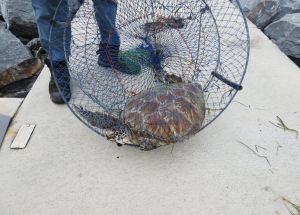
Turtle caught in crab pot
Here are a few simple things to do to help turtle and dugong in Moreton Bay:
- Download the Marine Parks Southern QLD phone app! Know where you need to go slow.
- Get the Go slow aerial map and Moreton Bay Marine Park User Guide .
- When boating, especially in shallow waters, slow down and be on the lookout for turtles and dugong.
- Report marine animal strandings.
- Be careful not to damage or destroy seagrass by careless anchoring or bait collecting. When digging for bait always replant the seagrass sods. Seagrass is their primary food source.
- When crabbing make sure you
- check your pots regularly and take them home at the end of the day
- use weighted rope and the correct length of line appropriate to the depth of water to prevent loose rope floating about in the water and causing increased risk of entanglement.
- Ensure that your crab pot is heavy enough to prevent it being lost in strong tidal currents
- use Styrofoam floats as plastic bottles can easily leak, break, flood and sink.
Further information
- There are currently no park alerts for this park.
Get the app!
Zone and designated area information for the Moreton Bay Marine Park and Great Sandy Marine Park.
