Turtles
Often called ancient mariners of the sea, turtles were plentiful during the reign of the dinosaurs more than 150 million years ago. Today their numbers are significantly reduced. Six of the world's seven species of marine turtle found in Moreton Bay. These species are considered either vulnerable or endangered under the Nature Conservation Act 1992 and under the Environmental Protection and Biodiversity Conservation Act 1999, where they are protected as ‘marine’ and ‘migratory’ species.
Turtles have extraordinary powers of navigation. They often return to nest at the same beaches where they hatched. Most sea turtles will migrate several hundreds of kilometres from their feeding grounds to mating grounds. A few turtles even travel up to two thousand kilometres on this journey.
Turtles in Moreton Bay Marine Park
Moreton Bay Marine Park is one of the few places in the world where large populations of turtles are found so close to a capital city.
The marine park has three resident marine turtle species:
- Loggerhead turtle (Caretta caretta)
- Green turtle (Chelonia mydas)
- Hawksbill turtle (Eretmochelys imbricata)
Marine turtles that visit or have small populations in the marine park are the olive ridley (Lepidochelys olivacea), flatback (Natator depressus) and the leatherback turtle (Dermochelys coriacea). The leatherback is a special visitor to Moreton Bay being the largest of the marine turtles. It has a unique physiology and is able to regulate its own body temperature and has a specialised diet of pelagic jelly fish when out on the open ocean.
Moreton Bay - essential feeding grounds
Moreton Bay’s habitats are extremely important to the marine turtle life cycle, fuelling marine turtle nesting migrations. The Bay has extensive seagrass meadows including core meadows at Moreton and Amity Banks. Herbivorous green turtles graze on these seagrass meadows, while carnivorous loggerhead turtles prey on creatures living within the meadows, including shellfish, crabs, sea urchins and jellyfish. Like the specialised reef hunter, the hawksbill turtle, loggerheads will also use the coral reefs, rocky reefs and coffee rock reef and ledges.
After a successful nesting migration, turtles return to the Bay to regain body condition and energy reserves. There may be two to eight inter nesting years before the next migration. Healthy and protected habitats in the marine park are essential to refuel marine turtles before their next nesting migration.
The marine park is not a major nesting area, however there is consistent nesting of green and loggerhead turtles on the sand islands of Bribie, Moreton, and North and South Stradbroke.
The race for survival
Population recovery rates for marine turtles are slow. A marine turtle can be aged between 30 to 50 years before it migrates to breeding grounds to breed, which may occur only once every two to eight years.
The temperature of the sand in which the eggs are incubated determines a hatchling's sex; warmer temperatures produce females and cooler temperatures produce males. Turtles hatching on islands within Moreton Bay Marine Park will mostly be males because of cooler sand temperatures than nesting locations further north. During the eight-week incubation period many eggs will be lost to predators, inundation by water and erosion.
After incubating, the hatchlings break out of their shells slowly and dig their way to the surface, ideally breaking out during the evening high tide. Hatchlings then instinctively race down the beach and into the open ocean. They begin a long and dangerous journey using wave direction, current and magnetic fields to orientate themselves to deeper water. Turtle hatchlings have a low chance of survival - only about one in 1000 hatchlings will survive to return as an adult to breed and nest on (or near) the same beach.
For the next 5-10 years these young turtles are rarely seen. When a turtle's shell reaches 35-40 centimetres in length it will reappear in shallow coastal waters. For some turtles, the feeding grounds of Moreton Bay Marine Park will be their home for many years to come.
Read more about watching and where to see turtles.
Exploitation of turtles
Turtles were once abundant in Moreton Bay Marine Park, however European settlement had a significant impact on the species. Commercial harvesting of marine turtles commenced in Queensland in 1867, with a substantial turtle neat and soup industry established in the Moreton Bay area by 1896. 1 Between 1924 and 1929 the expanding turtle soup industry significantly reduced the numbers of adult female green turtles in all feeding areas, including Moreton Bay. Moreton Bay's green turtles were taken from their nesting beaches in southern Great Barrier Reef rookeries to supply soup factories on North West and Heron islands. In 1927 the turtle processing operation moved to Brisbane. It wasn't until 1950 that green turtles became completely protected in Queensland waters. Today, legislation protects turtles from exploitation.
Under the Native Title Act 1993, traditional hunting of turtle is allowed for non-commercial purposes. In Moreton Bay Marine Park, relatively small numbers of turtles are hunted for cultural purposes.
Protecting turtles from threats
As south-east Queensland's population increases, so does the number of visitors to Moreton Bay Marine Park. Each year more turtles are becoming victims of disease, entanglement, boat strike and pollution. As well as having the highest known deaths from disease, Moreton Bay Marine Park accounts for approximately 50 percent of boat strikes reported in Queensland. Up to 50 turtles every year are found with boat strike related injuries.
Read more about vessel strike impacts on turtles.
Turtles are also seriously threatened by discarded fishing equipment and litter, which can cause injuries or even death from infection, amputation, choking and drowning. Turtle entanglements in crab pots are also an increasing problem in Queensland, with abandoned pots and their loose float lines accounting for up to 30 reported deaths each year.
Besides ingesting marine pollution, diseases can also be fatal for turtles. Diseases caused by bacteria, viruses and parasitic worms may cause a gaseous build up in their intestines and prevent them from diving. A number of turtles in Moreton Bay are infected with a disease called "Green turtle fibropapilloma disease" which causes tumours to grow on and inside the turtle and may result in death.
In the marine park, designated go slow areas are established to protect turtles from injury, disturbance or death caused by boat strike, especially in critical feeding and resting areas. To know where you need to go slow, download the Marine Parks Southern QLD phone app.
Seagrass meadows that provide important habitat for marine turtles, are protected in the marine park through specific zoning measures which prohibit certain fishing activities like trawling.
References and further reading
- Daley, B., Griggs, P. and Marsh, H. (2008). Exploiting marine wildlife in Queensland: the commercial dugong and marine turtle fisheries, 1847-1969. Australian Economic History Review 48 (3): 227-265.
Limpus, C. (1980) in Limpus, C.J., Couper, P.J. and Read, M.A. (1994). The green turtle, Chelonia mydas, in Queensland: population structure in a warm temperate area". Memoirs of the Queensland Museum 35:139-154
Shimada, T., Limpus, C., Jones, R. and Hamann, M. (2017). Aligning habitat use with management zoning to reduce vessel strike of sea turtles. Ocean and Coastal Management, 142: 163-172.
Sobtzick, S., Cleguer, C., Hagihara, R., and Marsh, H. (2017). Distribution and abundance of dugong and large marine turtles in Moreton Bay, Hervey Bay and the southern Great Barrier Reef. A report to the Great Barrier Reef Marine Park Authority.
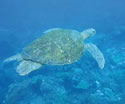
Turtle, Moreton Bay Marine Park.
Moreton Bay Marine Park is one of the few places in the world where large populations of turtles are found so close to a capital city.
- There are currently no park alerts for this park.
Get the app!
Zone and designated area information for the Moreton Bay Marine Park and Great Sandy Marine Park.
