About White Mountains
Park features
Covering 112,000ha, this rugged wilderness features spectacular white sandstone bluffs and gorges and is home to a wide variety of plants and animals.
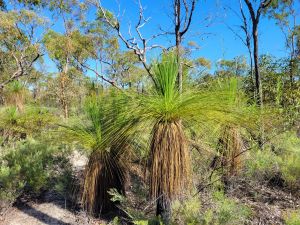
Stands of grass trees flourish in the national parks’ sandy soil.
Photo credit: © Linda Thompson
White Mountains National Park protects 14 different ecosystems in the Desert Uplands bioregion, making it one of inland Queensland's most botanically diverse national parks. Lancewood forests, open woodlands, laterite pastures, heathlands and spinifex grasslands are spotted around the white sandstone outcrops. Sand dunes and sandy flats feature in the Canns Camp Creek area. Brilliant wildflowers and a host of animals are found throughout the national park.
The national park is a vast parched landscape for most of the year. However, when seasonal conditions are favourable in the cooler months, the landscape blooms with a colourful wildflower display. Dissected by the Great Dividing Range the headwaters of three major catchments begin here. Water flows east through several smaller streams to the Burdekin River which eventually spills into the Coral Sea. The Flinders River flows north into the Gulf of Carpentaria. And water from Torrens Creek makes its way through to the channel country of western Queensland to eventually reach Lake Eyre in South Australia. The porous sandstone of White Mountains acts as a major recharge area for the Great Artesian Basin.
Read more about the natural environment of White Mountains National Park.
Looking after the park
Everything in the national park is protected including plants, animals, geological features and cultural sites. Please appreciate, respect and help care for White Mountains outstanding natural and cultural values by leaving things as you find them, and encouraging others to do the same by following these guidelines.
- Leave everything as you find it. Everything, living and dead, is protected including geological features, historical and cultural artefacts.
- Stop the spread of weeds, insect pests and pathogens. New introductions can spread and displace resident species and alter the local ecology. Soil from your vehicle, camping gear and boots can contain weed seeds, ants (and their eggs) and foreign plant pathogens. Before you arrive, clean your vehicle (especially the tyres and undercarriage), all camping equipment and walking gear. If available, use a washdown facility provided in a local town. Follow the come clean, go clean guidelines, and learn more about pest plants and animals and pathogens.
- Camp fires are permitted in the fire rings provided, except when QFD fire ban and restrictions or QPWS-imposed fire prohibitions are in place. Bring clean, pest free firewood such as untreated, mill off-cuts, collecting firewood from the national park is prohibited. Follow the Parks and forest guidelines for camp fires and cooking. Fuel or gas stoves are recommended.
- Keep food away from wildlife. Accidental or intentional feeding upsets the balance of nature and can make animals sick and/or aggressive. Never leave food or scraps around your camp site or in locations you visit in the national park.
- Manage your waste. Take rubbish with you when you leave as no bins are provided. Pack food away immediately after meals and secure rubbish in sturdy rubbish bag in a sealable animal-proof container to avoid attracting insects and larger animals. Never bury rubbish as animals will dig it up.
- Never contaminate water. Don't use soap, toothpaste or detergent in freshwater creeks and waterholes. Wash yourself and your cooking utensils at least 50m from waterways.
- Use toilets where provided. Where toilets are not available, bury toilet waste (and paper) at least 15cm deep and 100m away tracks and watercourses. Bag all personal hygiene products including disposable nappies and wet-wipes for disposal off-park.
- Never pour portable toilet waste into parks’ toilet, our toilets cannot cope with the waste or chemicals. Empty chemical toilets in approved toilet waste disposal facilities at Hughenden and Charters Towers.
- Domestic animals are not permitted in the national park. Please observe the before you visit guidelines for dogs and pets.
- Don’t use firearms, chainsaws or unregistered vehicles in protected areas.
- Leave your drone at home. Flying drones in the national park can have a negative impact on wildlife (particularly birds), affect visitor’s privacy and enjoyment of nature and impact First Nations peoples’ cultural heritage. The use of drones is prohibited in the camping area and strongly discouraged throughout the national park. Please follow drone-safety rules.
- Keep to designated tracks. Drive only on the formed roads as shown on map . Driving over vegetation, breaking branches, taking shortcuts and forming new tracks damages the environment. Much of the land surrounding the national park is privately owned. Only cross private land on a designated track with the landowner’s permission. Leave all gates as you find them. Be mindful, some maps show roads that are private and not open to the public.
- Never drive on rain-affected roads. Even if you make it through, your vehicle will damage the road surface and make it dangerous for other road users.
- Be considerate of others—ensure undue noise and dust from your driving does not upset other campers and park neighbours.
See the guidelines on caring for parks for more information about protecting our environment and heritage in parks.
Park management
White Mountains National Park was gazetted in stages from 1990. Queensland Parks and Wildlife Service manages the protected area to conserve its natural, cultural and historic values.
Tourism information links
Flinders Discovery Centre
www.visithughenden.com.au
37 Gray Street, Hughenden Qld 4821
Phone (07) 4741 2970
Email info@flinders.qld.gov.au
Flinders Shire Council
www.flinders.qld.gov.au
34 Gray Street, Hughenden Qld 4821
Phone: (07) 4741 2900
Email: flinders@flinders.qld.gov.au
Charters Towers Visitor Information Centre
www.visitcharterstowers.com.au
74 Mosman Street, Charters Towers Qld 4820
Phone (07) 4761 5533
Email tourinfo@charterstowers.qld.gov.au
For tourism information for all regions in Queensland see Queensland Holidays.
-
The natural, cultural and historical significance of White Mountains
- There are currently no park alerts for this park.