People–dingo interactions
Let them be wild

It is irresponsible and reckless to interact or interfere with a dingo. It endangers your life and that of the dingo. Watch dingoes from a safe distance. Never approach a dingo. It is also an offence and penalties apply.
Photo credit: Queensland Government
It is an offence to feed a dingo, attract it using food or food waste, or disturb it anywhere on K’gari, whether on public or private land. Penalties apply.
Dingoes are wild animals and unpredictable. K’gari dingoes have rarely interbred with domestic or feral dogs and, in time, may become one of the purest strains of wild dingo on the eastern Australian seaboard, possibly Australia-wide.
Dingoes search for prey and other food within well-defined home territories, across the island. K’gari’s dingoes are healthy and are naturally lean and fit. Pack leaders, or alpha males/females, appear healthier and well fed. Subordinate and scapegoat pack dingoes are generally leaner than the dominant animals.
- Read about Dingo ecology.
When you're in dingo territory
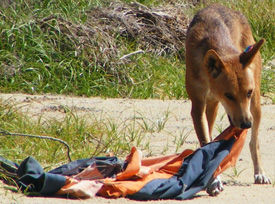
Dingoes sometimes approach campsites or houses to scavenge food and even personal belongings that have the scent of food on them.
Photo credit: Queensland Government
People and dingoes share high-use recreational sites including beaches and lake shores and this increased contact with people has turned many dingoes into a public nuisance. Some dingoes have become so high-risk that they have to be euthanised. This is done as a last resort, after thorough identification processes and consultation with Butchulla Traditional Owners, and is carried out humanely by a vet or trained and authorised rangers only.
Attracting and feeding dingoes make the animals less fearful of people and dependent on hand-outs. Hunting skills decline and they may become aggressive towards people who don't feed them.
Dingoes have a keen sense of smell and are attracted by activity and food smells. Sometimes they are simply curious.
When camping, living or working on K'gari you must store your food, rubbish and belongings securely. Making your camp site or house yard boring and unattractive to dingoes, means they may pass through and leave you and your belongings alone.
- Read further information to Be dingo-safe! on K'gari and read about what makes a dingo a 'dangerous' dingo.
What happens when people feed dingoes?

Let them grow up wild. Do not feed them. Fed dingoes become aggressive and may attack people particularly children.
Photo credit: Queensland Government
When dingoes are fed or scavenge rubbish, they often lose their effective hunting skills and start to depend on scraps and hand-outs. They also lose their natural fear of humans and expect food from everybody.
Dingoes then visit camps, picnic areas, resorts and residences, follow people and tear open tents looking for food. Pups from these dingoes may not be taught to hunt effectively; instead they grow up scavenging from these areas. As a result, they are no longer wary of people and often become familiar, aggressive and, on one occasion, a dingo tragically killed a child.
Dingoes have bitten visitors, occasionally quite severely, and are capable of killing people.
- Read about why feeding K’gari dingoes is a bad idea.
When dingoes come close
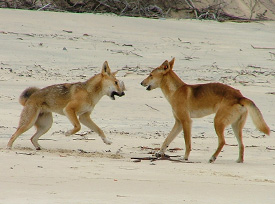
Dingoes will fight to gain dominance. People should not mistake this for playfulness.
Photo credit: Queensland Government
Dingoes will occasionally approach humans because they are naturally curious. They should be treated with absolute caution. Remember, these are wild and unpredictable animals.
Dingoes on K’gari have chased joggers and children who are playing. What appears as playful dog behaviour is actually serious dominance testing by the dingoes, which can lead to aggression. Avoid jogging and running as it can attract and excite dingo attention and trigger a negative interaction.
People walking alone have been threatened and nipped by dingoes. Stay in small groups.
Some dingoes visit lakes and hunt around the shorelines. They will snatch picnics and will open unsecured ice boxes, especially if they are on the ground. They may become aggressive when people try to pull food away. Don’t take food or drinks, except water, to lake shores.
Be aware that at Boorangoora (Lake McKenzie), all food and drinks, except water, are prohibited.
- Read further information about how to Be dingo-safe on K’gari.
Dingo attacks
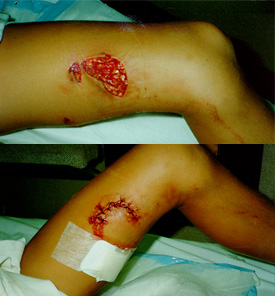
Dingoes have bitten visitors, occasionally quite severely, and are capable of killing people.
Photo credit: Queensland Government
People who feed or encourage dingoes contribute to those animals becoming familiar and habituated or learning to associate food with people, and the need to dominate for access to food—a natural instinct of a wild predator. This leads to dominance testing against people, and often children are targeted. If successful, the dingoes then move into more and more aggressive tactics to get access to food. This can result in serious bites or mauling and in some cases small groups of three or four dingoes have attacked together. This frightening experience for people is often directly related to someone who has fed or encouraged these dingoes in the past.
If you feel threatened by a dingo:
- be big and brave
- face the dingo
- if in pairs, stand back to back
- be loud and yell ‘HELP!’ and ‘din-go away!’
- calmly back away to a fenced area or vehicle
- never run
- report the dingo interaction to a ranger.
Read further information about how to Be dingo-safe! on K’gari.
Dingoes and children
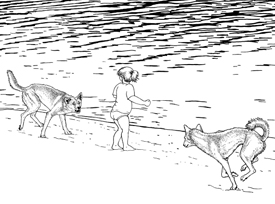
Dingoes move quickly! Always stay very close to your children.
Photo credit: Illustration: Maria-Ann Loi for Queensland Government
Always stay very close to your children. Many children are scared by dingoes. Some have been bitten by dingoes that want food or have been excited by children’s movements. Children are vulnerable because their size does not intimidate a dingo as much as an adult person. Even small teenagers are at risk.
Do not expect your children to remember what to do if a dingo comes close or threatens them. Parents: stay alert! Dingoes move quickly. Stay very close to your children (within arm's reach) and never let them sleep in a tent without adults.
Watch this short safety video clip for quick information.
Download the Be dingo-safe! guide and children’s activity booklet to help kids learn how to be dingo-safe on K’gari to take to the island with you.
Bush toileting? Never go alone!
People who need to bush toilet generally sit in a squatting position. This makes them vulnerable to dingo bites. Be dingo-safe! Never go alone.
Photo credit: Queensland Government
Toilet facilities are available, but sometimes visitors have to bush toilet. Everyone should take care when bush toileting on K’gari.
Some of the beach camping areas are popular for large groups, such as backpacker groups. These beach areas are cleared areas, behind the foredunes and have few or no facilities. Noise and cooking smells will attract dingoes that may stay out of sight, waiting for an opportunity to steal some food. People needing to bush toilet—especially women and children—should never go alone, in case dingoes are around. One person should always stand nearby and keep a look out for dingoes.
Dingoes are attracted to and will try to dig up bush toilet sites. Always dig a very deep hole—at least 50cm deep (knee-deep) and 50m from any watercourse—and bury your toilet waste (including used toilet paper) as soon as you have finished. Do not bury soiled sanitary items and nappies or leave them lying around. Place these items into a bag and a sealed rubbish container, and bin them as soon as you can.
It is recommended that campers who choose to camp in low or no facility areas bring their own portable toilet and use the portable toilet waste disposal facilities located across the island. Waste disposal locations include the southern entrance to Cornwall’s beach camping area and the Dundubara campground entrance track. Do not bury chemical toilet waste.
Fishing

Dingoes will catch fish in the shallows off the beach or from temporary lagoons that form between the water’s edge and the foredunes.
Photo credit: Queensland Government
The beach on K’gari is dingo territory too. They roam along the shore looking for any washed up remnants of dead marine life. They are attracted to anything left lying on the beach—buckets, plastic bait bags, berley sacks, baited fishing rods, etc.—and will investigate anything for traces of food.
When fishing, keep fish and bait in sealed containers or in your vehicle. Cover baited rod hooks. This also applies to berley. Fish cleaning in all campsites is prohibited. Certain areas along the beach, high visitation sites or entrances to townships, are designated ‘Fish cleaning prohibited’ areas and are clearly signposted.
Bait and fish should be kept with you in shoulder bags or in the vehicle. Do not leave anything in open beach buckets and keep berley and fish remains in sealed containers; not tied to the outside of the vehicle.
Bury fish offal and remains in a deep hole (50cm at least), just below the high tide mark. Do this when there are no dingoes around to stop them associating food with people. Large penalties apply for feeding or making food available to dingoes. This also applies to berley bags that are hung outside the vehicle. Keep all fishing tackle, bait and your catch secure.
Report dingo encounters
Report negative dingo encounters—circling, lunging or being chased or bailed up by one or more dingoes, tearing tents or stealing property, nipping, biting or worse—to a QPWS Ranger or phone (07) 4127 9150 as soon as possible. Mobile phone charges may apply.
For all emergencies, phone Triple Zero (000).
If you are hearing or speech impaired text 106.
For all non-urgent medical assistance, phone 13 12 33.
If you have information about any other encounter with a dingo you can email Dingo.Ranger@detsi.qld.gov.au with the details.
 Open larger image
Take note of the features of any threatening animal—all dingoes have unique variations, which makes identification easier.
Photo credit: Illustration Ⓒ Maria-Ann Loi for Queensland Government
Try to remember a few distinguishing features of the dingo
Dingoes don’t all look the same. They have different markings—socks, tail tips, scars—which help rangers profile the animal.
Remember QPWS rangers profile all known dingoes and positive or neutral encounters are welcome too.
- Moon Point Road partially CLOSED K’gari (Fraser Island Recreation Area) 14 January 2026 to 30 January 2027
- Northern Forests scenic drive CLOSED, detour in place 7 September 2026 to 7 September 2027
- Urgent Repairs for Lake Allom Facilities 1 October to 1 November 2026
- Northern Road Partial Closure - Urang Creek 29 September to 29 December 2026
- Cornwells Road partially closed, K'gari Recreation Area 12 March 2026 to 30 June 2027
- Beach camping zone 9 – Diray and Carree CLOSED 20 June 2025 to 29 January 2027
- Infrastructure upgrades planned for Waddy Point and Central Station - April to November 2026 16 February to 9 November 2026
- Park Alert-Tukkee Wurroo (Indian Head) walking track temporary closure 14 June 2021 to 18 November 2026
- Partial Closure of Wanggoolba Creek Boardwalk 25 May 2026 to 26 January 2027
- Wongari (Dingo) Rearing and Emergence Season 1 September to 30 November 2026
- Waddy Beach Front Camping Area: Campsite Booking Restrictions - Dingo Management 14 August to 15 December 2026
- Planned Maintenance - Lake Wabby walk 10 August to 9 November 2026
- Happy Valley Beach Access Ramp and Boardwalk Reconstruction 30 July to 14 December 2026
- SEVERE EROSION – Inskip barge landing beach access tracks 25 March 2026 to 30 January 2027
- Ngkala Rocks to Sandy Cape Beach Conditions 20 June 2025 to 29 January 2027
- K'gari Great Walk 1 March to 31 October 2026
- Drones prohibited Lake McKenzie (Boorangoora) 21 December 2025 to 10 December 2026
- Beware crocodiles
- Be dingo-safe
- Beware marine stingers (jellyfish)
Conditions report
K'gari conditions report Updated 7 Oct 2026
Critical information for your safety is included in the conditions report—always check it before you visit.
Increased fines for disturbing, feeding dingoes
It is illegal to disturb or feed wongari (dingo), which includes attracting them with food or food waste. On K’gari an increased maximum fine of $28,495 and an on-the-spot fine of $2,763 now apply to those people who break the law.
Be dingo-safe.