About Blackdown Tableland
Park features
Rising dramatically above the surrounding plains, Blackdown Tableland features spectacular sandstone scenery with deep gorges, tranquil creeks and trickling cascades.
Located at the northeastern edge of the central Queensland sandstone belt, the national park supports diverse plant communities including heathlands, dry eucalypt forests and moist pockets of ferns, mosses, and orchids. Being elevated, the tableland is often cooler and moister than nearby plains. Its isolation means plants and animals that are found nowhere else thrive here. These include the Blackdown stringybark, a macrozamia, red bottlebrush, the Blackdown ‘monster’ (a type of underground cricket) and a Christmas beetle.
This is Ghungalu Country. The tableland’s varied landscapes are of great cultural significance to the Ghungulu people.
Learn more about the natural, cultural and historical significance of Blackdown.
Looking after the park
Everything in Blackdown Tableland National Park is protected including plants, animals, rocks, waterholes and springs, cultural sites and heritage places. Please appreciate, respect and help care for Blackdown Tableland’s outstanding natural and cultural values by leaving things as you find them, and encouraging others to do the same by following these guidelines.
Respect First Nation peoples' culture
Cultural sites represent thousands of years of connection to this landscape for the Ghungalu people. Cultural sites and places of special significance are irreplaceable and easily damaged. Stay on the designated walking tracks, keep out of waterholes of special significance, and travel lightly through Country.
Visit and camp softly
- Stop the spread of weeds, insect pests and pathogens. New introductions can spread and displace resident species and alter the local ecology. Soil from your vehicle, camping gear and boots can contain weed seeds, ants (and their eggs) and foreign plant pathogens. Before you arrive, clean all vehicles (especially the tyres and undercarriage), all camping equipment and walking gear. If available, use a washdown facility provided in a local town. Follow the Come clean, Go clean guidelines and learn more about pest plants and animals and pathogens.
- Keep food away from wildlife. Accidental or intentional feeding upsets the balance of nature and can make animals sick and/or aggressive. Never leave food or food scapes around your camp site or a day-use area.
- Camp fires and cooking. Camp fires are permitted in the fire rings provided at each camp site (except when QFD fire bans and restrictions or QPWS-imposed fire prohibitions apply). Bring your own clean firewood such as untreated, milled off cuts. Collecting firewood from the national park is prohibited. Extinguish your camp fire with water when you leave. It is recommended to use a fuel stove.
- Manage your waste. Take rubbish with you when you leave, bins are not provided. Secure rubbish in a sturdy rubbish bag in a sealable animal-proof container. Dispose of rubbish at off-park waste disposal facilities (Blackwater or Rockhampton) or take it home with you for disposal or recycling. If you pack it in, pack it out!
- Water is not provided. Bring enough for all your drinking, cooking and cleaning. Treat before drinking any water collected in the park
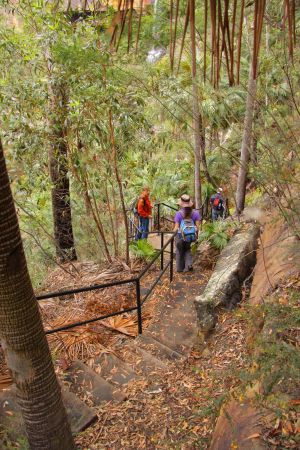
Venture down a series of steep steps and stairs to Gudda Gumoo Gorge.
Photo credit: John Augusteyn © Queensland Government
- Protect the waterways. Do not use detergent, soap or shampoo in or near waterholes or creeks. Wash yourself and your dishes 100m away from watercourses.
- Use toilets where provided. Where toilets are not available—bury faecal matter (and paper) at least 15cm deep and 100m away from tracks and watercourses. Bag all personal hygiene products including disposable nappies and wet wipes for disposal off park.
- Do not use firearms, chainsaws or unregistered vehicles in protected areas.
- Domestic animals are not permitted in the national park. Please observe the before you visit guidelines for dogs and pets.
- Stay on the designated vehicle tracks. Remember, all Queensland road rules apply on the national park vehicle tracks.
- Keep to the designated walking tracks. Creating new tracks damages the environment and causes erosion .
- Be considerate. Keep noise levels reasonable. People visit national parks to enjoy the sound of nature and the peace it provides, not noisy music. Smoke away from other visitors, and pocket your cigarette butts—for more information see smoking restrictions in national parks.
- Leave your drone at home. Flying drones in the national park can have a negative impact on wildlife (particularly birds), affect visitor’s privacy and the Ghungalu peoples’ cultural heritage. The use of drones is prohibited in the camping area and strongly discouraged throughout the national park. Please follow drone-safety rules.
Please follow the caring for parks and forests guidelines.
Park management
The department manages Blackdown Tableland National Park for the conservation of our natural and cultural heritage in co-operation with the Ghungalu people through a Memorandum of Understanding (MoU) signed in 2003.
Tourism information links
Central Highlands Visitor Information Centre
centralqueenslandhighlands.com.au
3 Clermont St, Emerald Qld 4720
ph (07) 4982 4142
email emerald@chdc.com.au
Central Highlands Regional Council
https://chrc.qld.gov.au
Corner Egerton and Borilla Streets, Emerald Qld 4720
ph: 1300 242 686
enquires@chrc.qld.gov.au
Explore Rockhampton Visitor Information Centre
www.explorerockhampton.com.au
176 Gladstone Road, Rockhampton Qld 4700
ph: (07) 4936 8000
email: tourism@rrc.qld.gov.au
For tourism information for all regions in Queensland see Queensland Holidays.
-
The natural, cultural and historical significance of Blackdown Tableland National Park.
- Closure 4WD Loop Road 30 July to 1 November 2026