Visiting Blackdown Tableland safely
Getting there and getting around
Blackdown Tableland National Park lies in central Queensland 183km west of Rockhampton. The signed turn-off to the national park is on the Capricorn Highway 11km west of Dingo or 35km east of Blackwater.
From the turn-off, follow Charlevue Road for 16km to the base of the tableland. The 6km drive from the base of the tableland to Yaddamen Dhina is narrow, winding and steep. The road is not suitable for towing caravans or heavy trailers.
All roads past Yaddamen Dhina are unsealed (gravel), narrow and winding. Many locations are accessible with a 2WD vehicle driven with caution. A 4WD vehicle is recommended for the road beyond Munall camping area. The 4WD Loop Road to Mitha Boongulla is rough and difficult, and is suitable for high clearance 4WD vehicles only.
Before you arrive, remember to:
- Check Queensland Traffic or the local council office for current road conditions to access the national park.
- Check Park alerts for Blackdown Tableland National Park for the latest information on access, closures and conditions.
- Check Bureau of Meteorology for current weather and warnings.
Wheelchair accessibility
Wheelchair-accessible toilets are available at Yaddamen Dhina and Munall camping area. The walking track from the car park at Yaddamen Dhina to the lookout is wheelchair-accessible (assistance required).
Staying safe
Be well prepared and responsible for your own safety—even on a short stroll.
The national park is semi-remote, and rangers may not be available to help you. You must be self-sufficient and well prepared for all emergencies and responsible for your own safety—even on a short stroll.
When walking
- Mind your step! Be aware that pea gravel (that occurs naturally) on the walking tracks makes the ground slippery under foot.
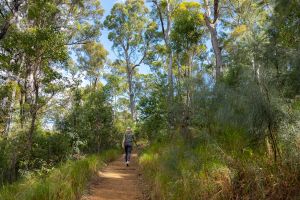
Take care on the walking tracks. Heed all safety advice and be mindful of pea gravel, it’s slippery!
- Never walk alone. Always let a responsible person know where you are going and when you expect to return. Plan to finish your walk in the daylight.
- Keep to the designated marked walking tracks, stay behind safety barriers, heed all safety, and access signage.
- Walk with care. Cliff edges are sheer and may be unstable—keep well back from the edge. Supervise children closely. Significant injury or death can result from a slip or fall.
- Take care at creek crossings, rocks may be uneven and slippery.
- Never dive or jump into creeks. Creeks and waterholes hide dangers such as submerged logs and rocks; water depth is variable and unpredictable.
- Wear protective clothing and sturdy enclosed footwear, a hat and sunscreen. Avoid exercise in the heat of the day.
- Remember to pack drinking water, extra food, a first-aid kit and at least one form of communication equipment.
When driving
- Queensland road rules apply on the national park roads.
- Drive slowly to avoid locking your brakes and losing control.
- Always be alert for other vehicles, especially when approaching blind corners.
- Ensure that your vehicle is in sound mechanical order. Drive according to the road conditions, plus you and your vehicle’s capabilities.
In an emergency
For all emergencies, call Triple Zero (000).
There is variable mobile phone coverage at Yaddamen Dhina lookout only. Satellite phones and Personal Locator Beacons (PLBs) are the most effective in the national park.
We recommend you visit the Triple Zero website before visiting the national park.
You can also download the free emergency+ app before you leave home, the GPS functionality can provide critical location details to emergency services. Important: if there is no mobile coverage on any network, you will not be able to reach the Emergency Call Service via a mobile phone.
Please read the stay safe and visit with care information.
Before you visit
Essentials to bring
Prepare well and remember to bring:
- Enough food and water—there is no drinking water provided.
- A first-aid kit—and know how to use it.
- Reliable communication equipment.
- Sturdy enclosed footwear.
- Sun protection—wear a hat, shirt and sunscreen, even on overcast days, to avoid sunburn.
- Secure containers to store food and rubbish so that it is inaccessible to wildlife—rubbish bins are not provided.
- Firewood—bring only clean milled timber for use as firewood. Collecting fire wood and kindling in the national park is prohibited.
- Enough fuel for your visit.
Opening hours
Blackdown Tableland National Park is open 24 hours a day. Areas of the national park may be closed at times due to severe weather or park management operations. Check Park alerts for Blackdown Tableland National Park for the latest information on national park access, closures and conditions.
Permits and fees
Camping
If you intend to camp you will need a camping permit. Fees apply. A camping tag or booking with your details must be displayed at your camp site.
- Book your campsite online.
- If you cannot book online, see camping bookings for other options.
Other permits
Various activities conducted in the national park may require a permit. These activities include commercial tours, geocaching, social events (such as weddings), organised group visits, school excursions, scientific research, and sale of photographs or vision of Blackdown Tableland National Park. See, Permits and fees for further information.
Pets
Dogs and other domestic animals are not permitted in Blackdown Tableland National Park.
Climate and weather
Daytime temperatures average 24-30°C in summer and 5-15°C in winter. Be prepared for cool nights, particularly in winter when temperatures can fall below 0°C. Dense fog often blankets the tableland. Weather forecasts are available from the Bureau of Meteorology.
Fuel and supplies
Fuel and supplies are available at Dingo, approximately 29km from the national park boundary.
- Authorised Pest Management 22–28 November 2026
- Authorised Pest Management 25–31 October 2026
- Closure 4WD Loop Road 30 July to 1 November 2026