Be dingo-safe communication resources
The Queensland Government is committed to making sure all visitors to K’gari have safe, enjoyable and sustainable experiences. Visitor safety is our top priority and we continue to implement a range of management, communication and engagement activities year-round.
Dingo risk mitigation measures include regular and targeted ranger patrols, signage, park alerts for heightened dingo activity, and deterrents including exclusion fencing.
These activities are supported by our extensive Be dingo-safe public safety education campaign which aims to influence K’gari visitors to adopt specific behaviours to reduce the risk of negative dingo interactions. Dingo safety guidelines include:
- Never feed dingoes.
- Always stay within arm’s reach of children, even small teenagers.
- Walk in groups.
- Carry a long dingo safety stick when outside a fenced area.
- Do not run. Running or jogging can trigger a dingo’s instinct to chase.
- Camp in fenced areas, when possible.
- Secure all food, rubbish, fish and bait.
- Never store food or food containers in tents.
- Don’t take food or drink (except water) to the lakeshores.
The following communication resources can be used to help visitors understand dingo safety do’s and don’ts.
Social media tiles
To download the social tiles, click on the image to enlarge, right mouse click and select ‘save image as’.
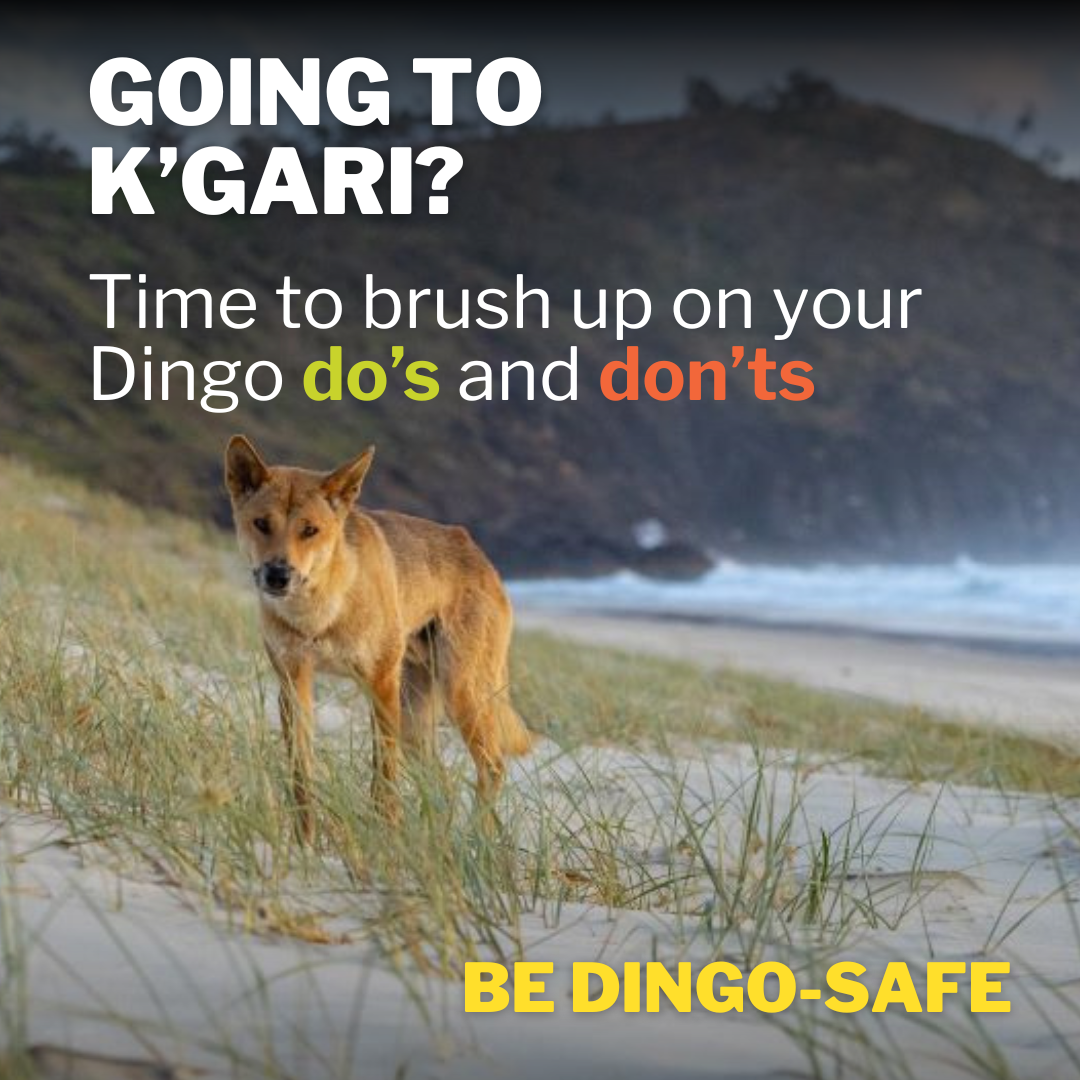
Going to K’gari? Time to brush up on your dingo do’s and don’ts
 Open larger image
Be dingo-safe social tile - Dingo do's and don'ts
- Always carry a dingo safety stick, to deter dingoes and keep them at a distance.
- Always keep kids within arm’s reach, in case a dingo appears.
- Camp in fenced campgrounds, surrounded by dingo-deterrent fences, and keep your campsite boring and unattractive to dingoes.
- Never run or jog outside fenced areas as it can attract a dingo’s attention and trigger their instinct to chase.
- Don’t be alone as this increases your chances of being threatened by a dingo.
Learn all the dingo safety tips at: www.qld.gov.au/BeDingoSafe
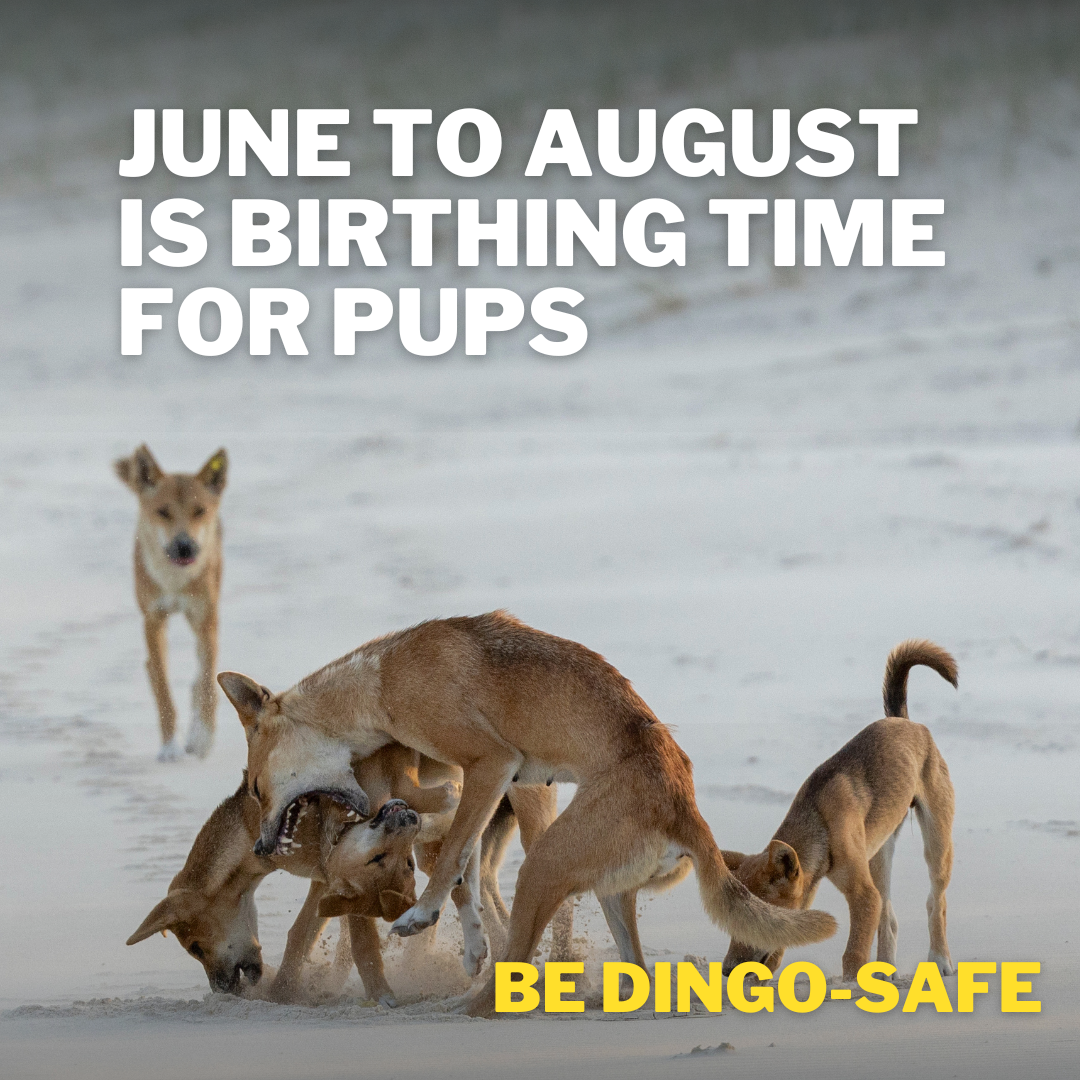
Winter: June to August is birthing time for pups
 Open larger image
June to August is birthing time for pups
Birthing time on K’gari means:
- Male and female dingoes become more aggressive to protect their pups.
- Female dingoes are on the hunt to feed themselves and their pups.
- Never get in between adults and pups.
- Drive slowly and watch out for dingoes on the beach and in the bush to keep them safe.
Make sure your trip is dingo-safe: visit www.qld.gov.au/BeDingoSafe
Spring: From September to November, pups emerge and are learning to hunt
 Open larger image
Be dingo-safe social tile - September to November, pups emerge and learn to hunt
Dingo pups are learning to hunt on K’gari, which means:
- They are maturing and beginning to explore beyond their dens.
- Pups remain near their parents, but occasionally, are left in a secure location while the adults go hunting for food.
- It's important to note that they haven't been abandoned, their pack won’t be too far away! Do not interact with pups who may appear to be alone.
- If food from humans is available, pups may not learn natural hunting skills.
Make sure your trip is dingo-safe: visit www.qld.gov.au/BeDingoSafe
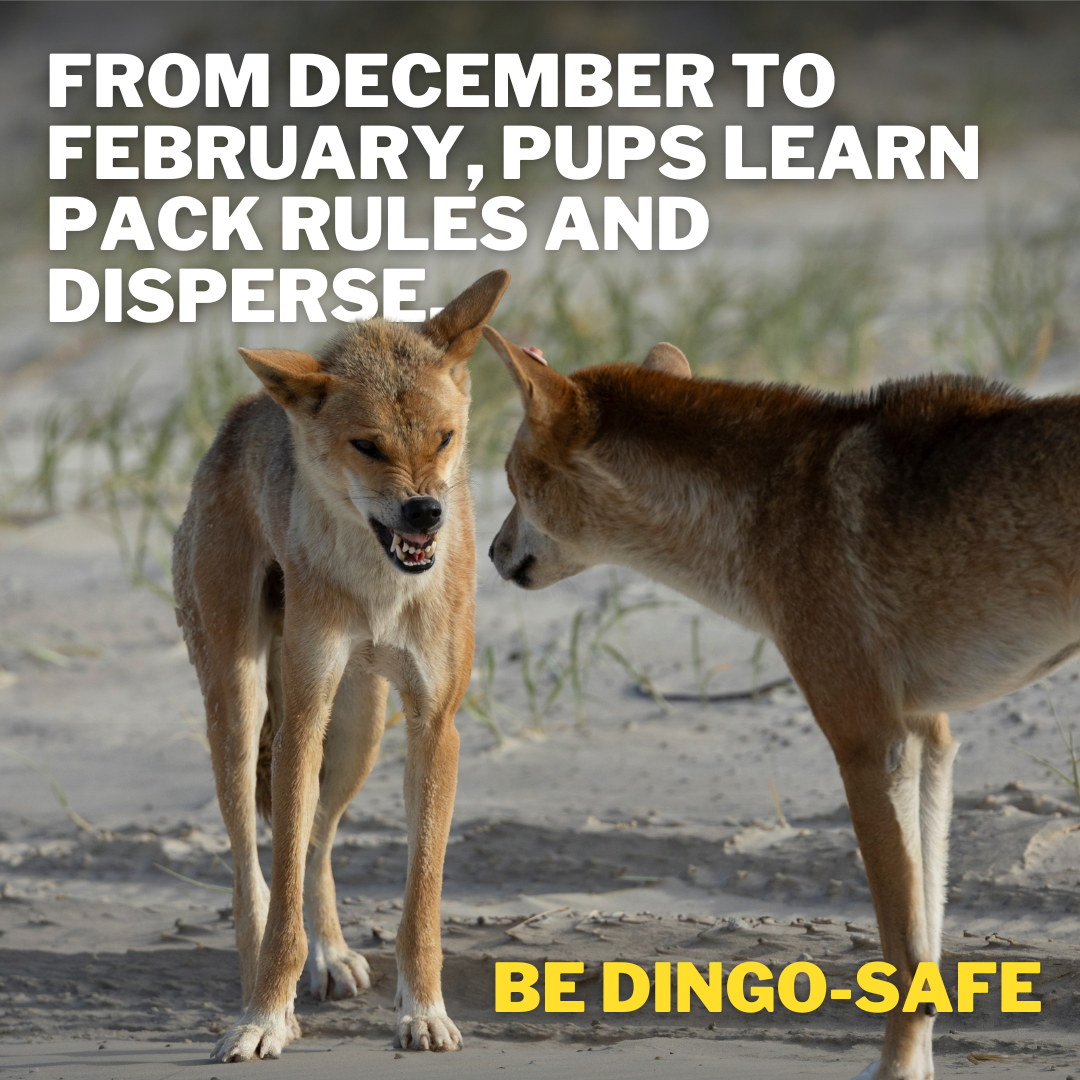
Summer: From December to February, pups learn pack rules and disperse
 Open larger image
Be dingo-safe social tile - December to February, pups learn pack rules and disperse
- Summertime on K’gari means dingo pups have grown into juveniles.
- They start learning pack rules: growling, howling, and showing aggressive behaviour to gain dominance over their siblings.
- This behaviour can also be directed at people, including young children, with an expected increase in human-dingo interactions.
- What may look like playful behaviour is often serious dominance-testing and can lead to aggression.
- Juveniles can quickly learn bad habits such as stealing food rather than learning natural hunting skills.
Make sure your trip is dingo-safe: visit www.qld.gov.au/BeDingoSafe
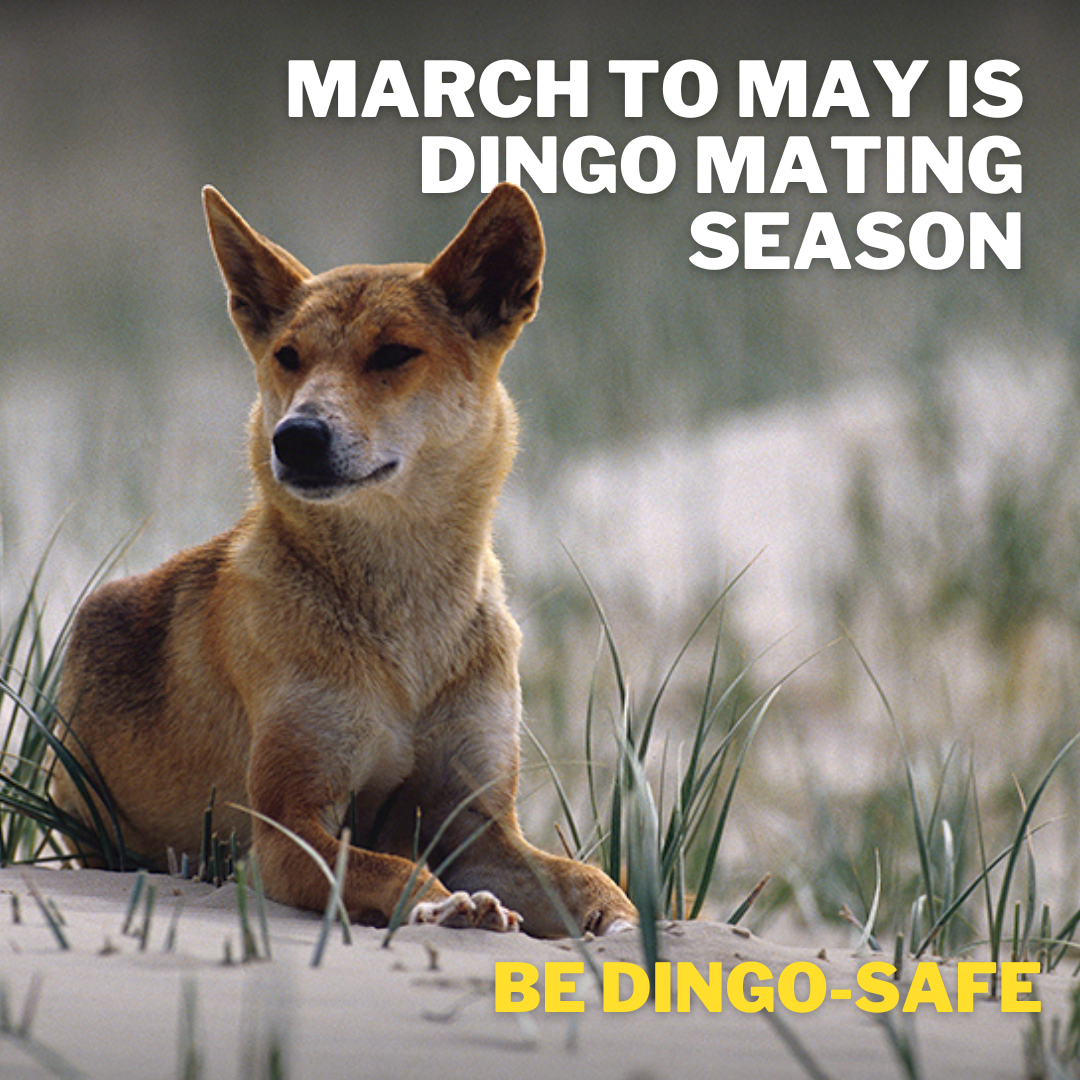
Autumn: March to May is dingo mating season
 Open larger image
Be dingo-safe social tile - March to May is dingo mating season
- March to May is dingo mating season on K’gari
- Adult males test their dominance, protect territories and expel intruders from other packs.
- Fights during mating season are a regular occurrence and some dingoes may also try to dominate humans by snarling, nipping or biting.
- The risk of a negative human-dingo interaction is greatest at this time.
Make sure your trip is dingo-safe: visit www.qld.gov.au/BeDingoSafe
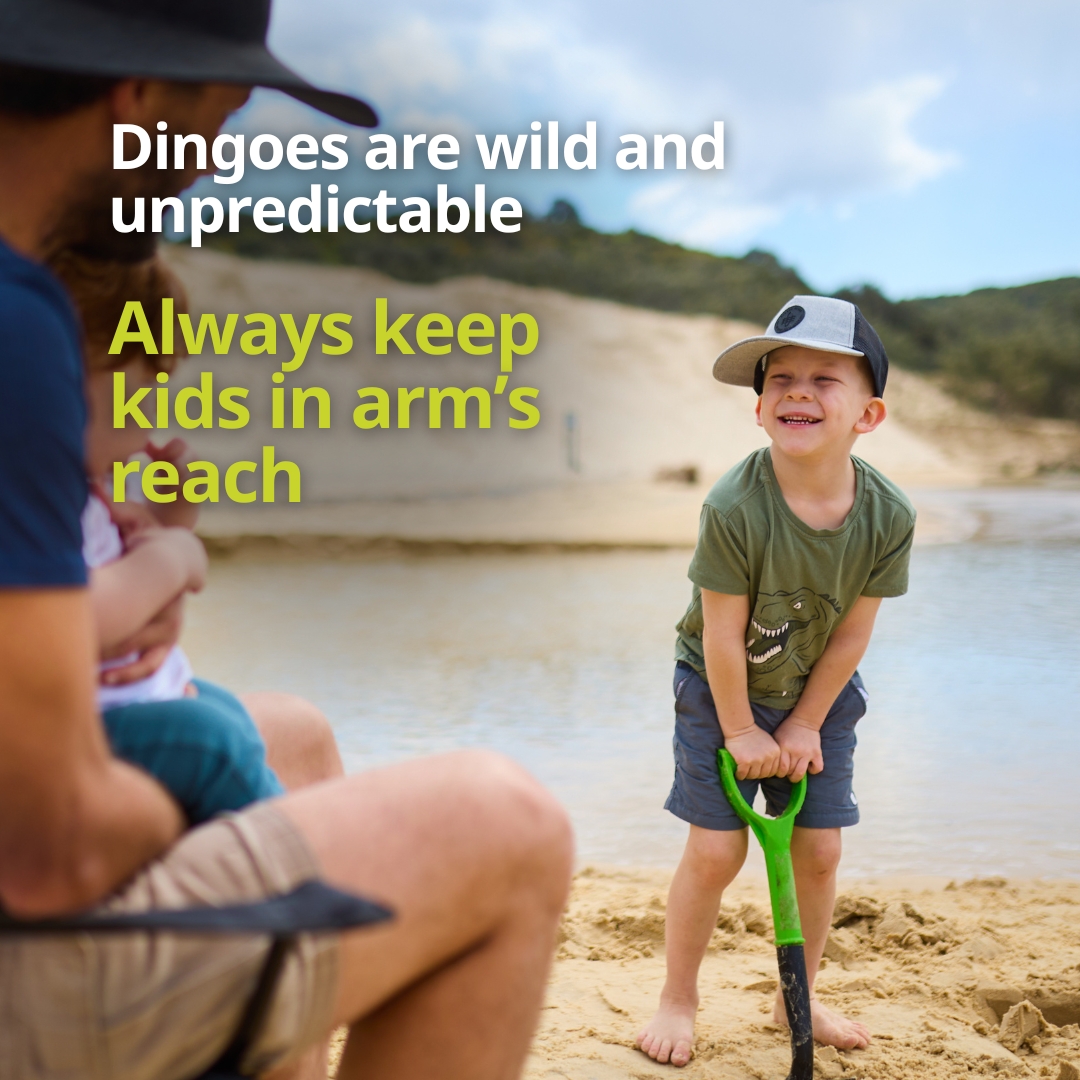
Dingoes are wild and unpredictable. Always keep kids within arm’s reach
 Open larger image
Be dingo-safe social tile - Always keep kids within arms reach
- What does “within arm’s reach” really mean when it comes to dingo safety? Well, it means within arm’s reach… literally!
- When visiting K’gari, it’s crucial to keep your children within arm’s reach in case a dingo appears. Never leave them unattended outside of fenced areas.
- Dingoes are fast and unpredictable. Even if you don’t see a dingo, it may be watching you and your young ones. While you may only be a few metres away, this distance can put your child in a dangerous situation.
Find more dingo safety tips at: www.qld.gov.au/BeDingoSafe
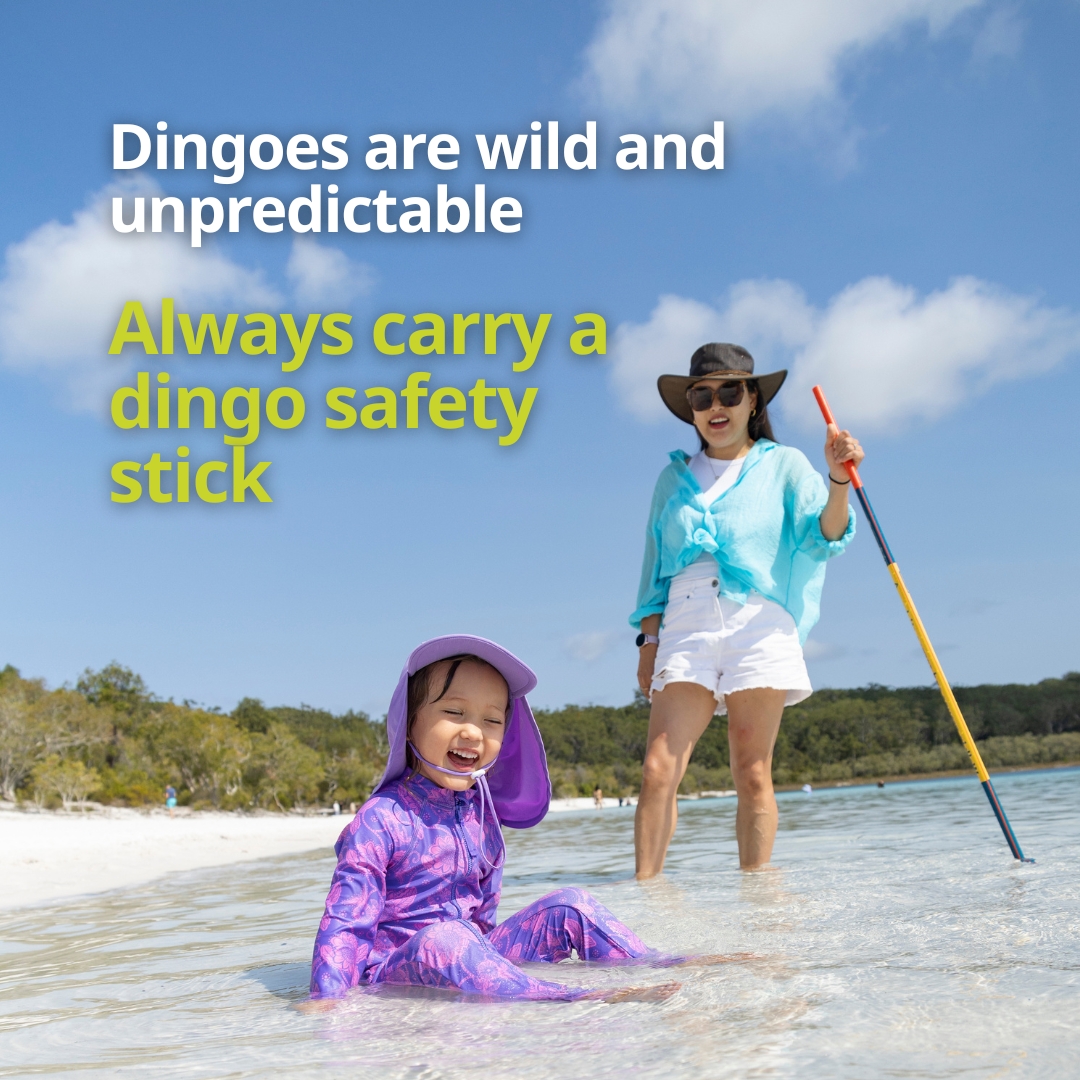
Dingoes are wild and unpredictable. Always carry a dingo safety stick
 Open larger image
Be dingo-safe social tile - Always carry a dingo safety stick
Visiting K’gari? Always carry a dingo safety stick!
A dingo safety stick is any stick that helps keep dingoes at a distance, should one approach you on K’gari.
It can be anything long and sturdy, like:
- an umbrella
- a hiking pole
- a fishing rod or rod holder
- a length of plastic pipe.
If you’re approached by a dingo, use the safety stick to keep a safe distance between you and the animal as you back away calmly and slowly to a safe place.
Find more dingo safety tips at: www.qld.gov.au/BeDingoSafe
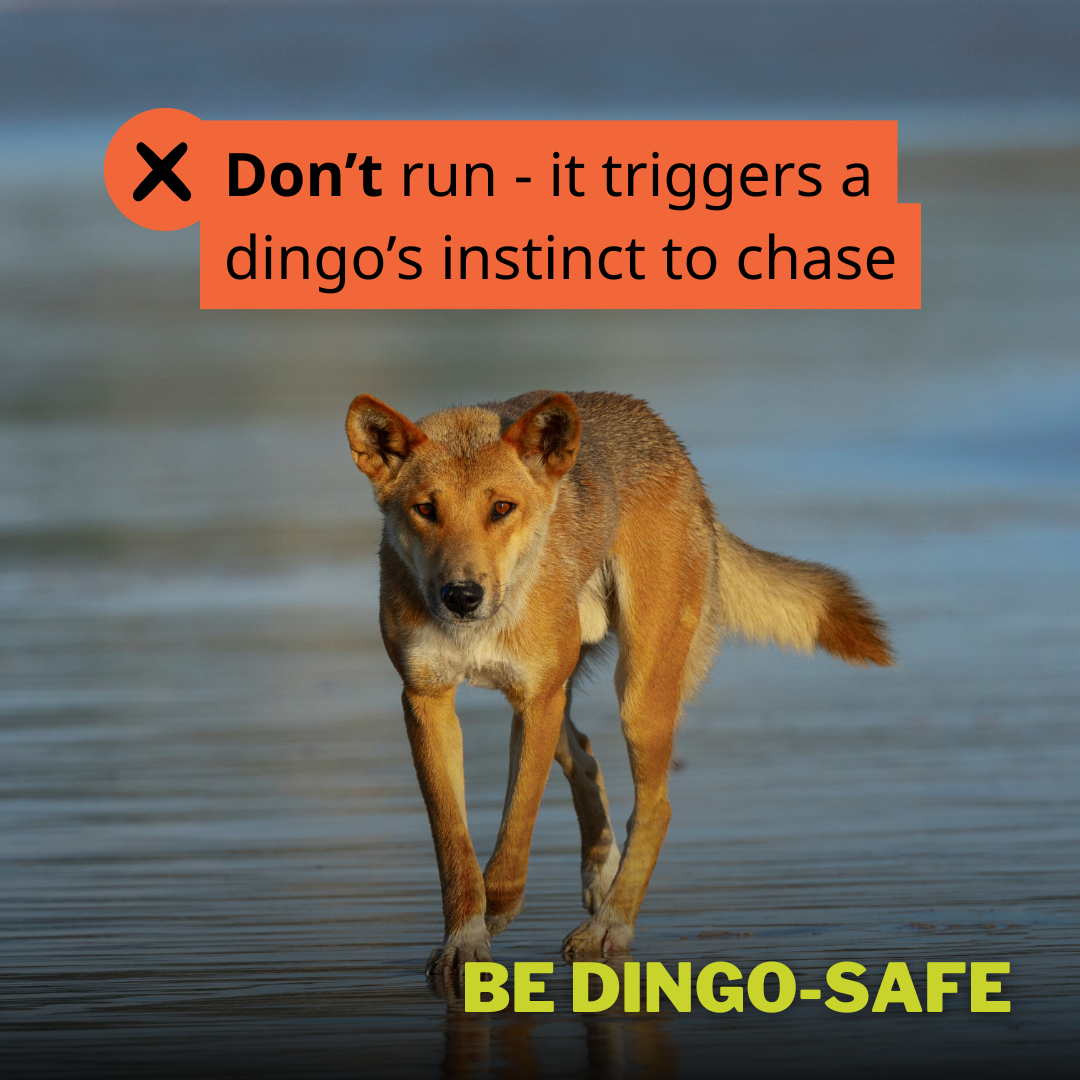
Do walk, do not run – running triggers a dingo’s instinct to chase
 Open larger image
Be dingo-safe social tile - Do walk, don’t run – running triggers a dingo’s instinct to chase
Never run or make sudden movements as this can trigger a dingo's instinct to hunt!
Find more dingo safety tips at: www.qld.gov.au/BeDingoSafe
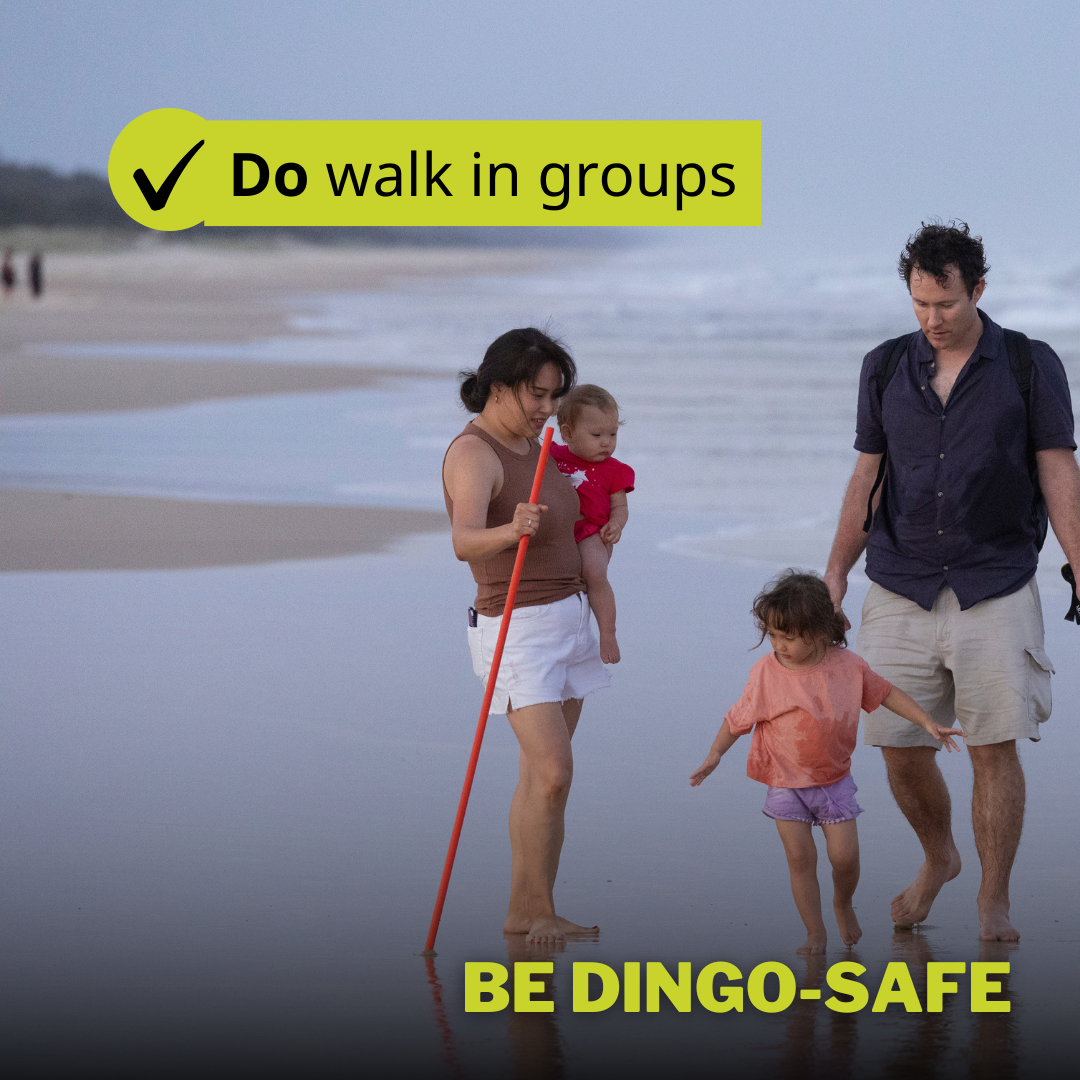
Do walk in groups
 Open larger image
Be dingo-safe social tile - Do walk in groups
Remember to stay vigilant on K’gari as dingoes may be closer than you think. They can be anywhere at any time and they move quickly!
Don’t be alone as this increases your chances of being threatened by a dingo.
Find more dingo safety tips at: www.qld.gov.au/BeDingoSafe
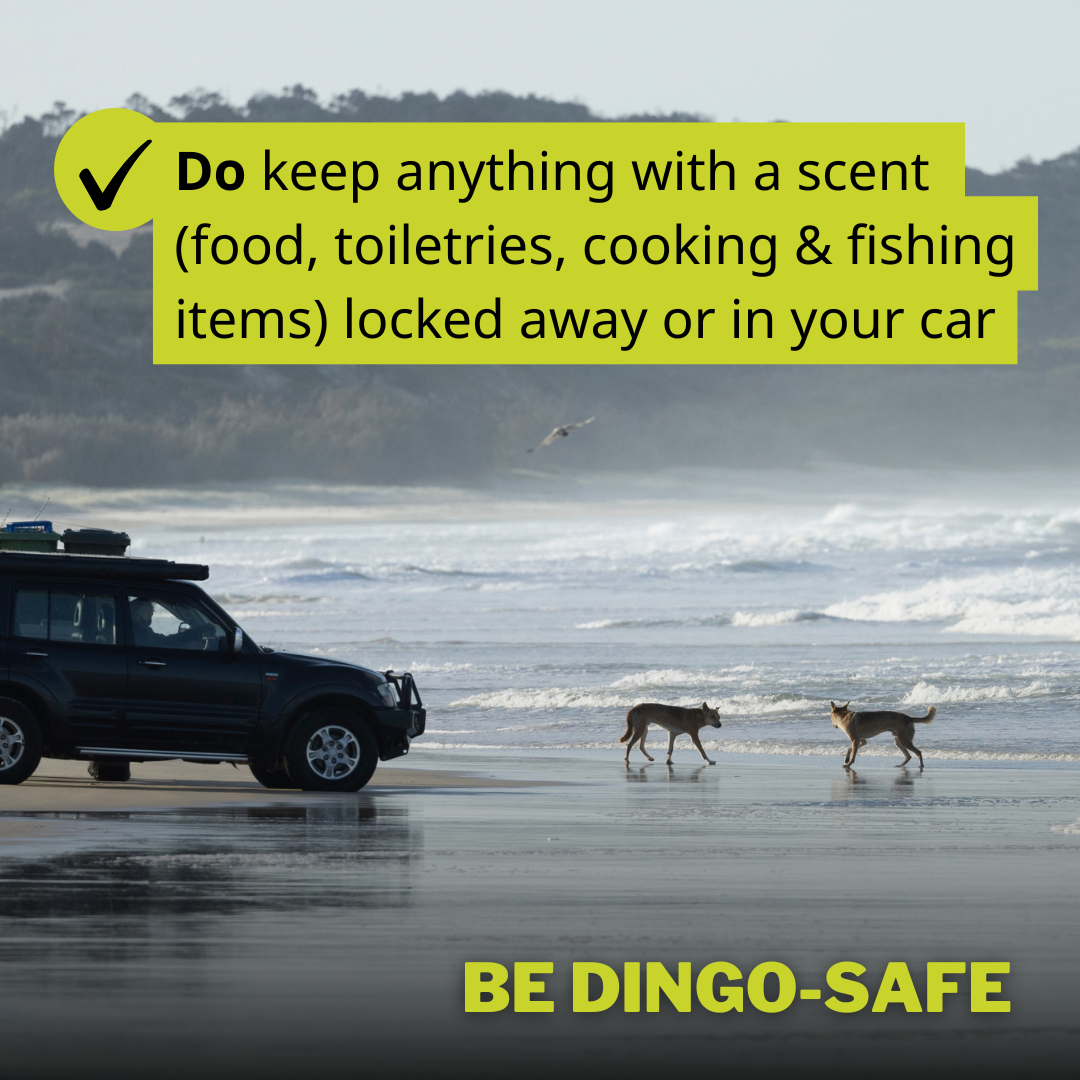
Do keep anything with a scent (food, toiletries, cooking and fishing items) locked away or in your car social
 Open larger image
Be dingo-safe social tile - Do keep anything with a scent locked away or in your car
While on K’gari, make sure to protect your belongings and practice safe storage!
Dingoes have a keen sense of smell and will seek out anything scented including toiletries and used cooking utensils.
Securely store food, rubbish, cooking, cleaning and fishing items in locked containers, preferably with metal clips, or in your car.Do dispose of rubbish correctly so as not to attract dingoes hunting for food.
Remember, fines apply to those who feed, attract, disturb or leave food items available for dingoes on K’gari.
Find more dingo safety tips at: www.qld.gov.au/BeDingoSafe
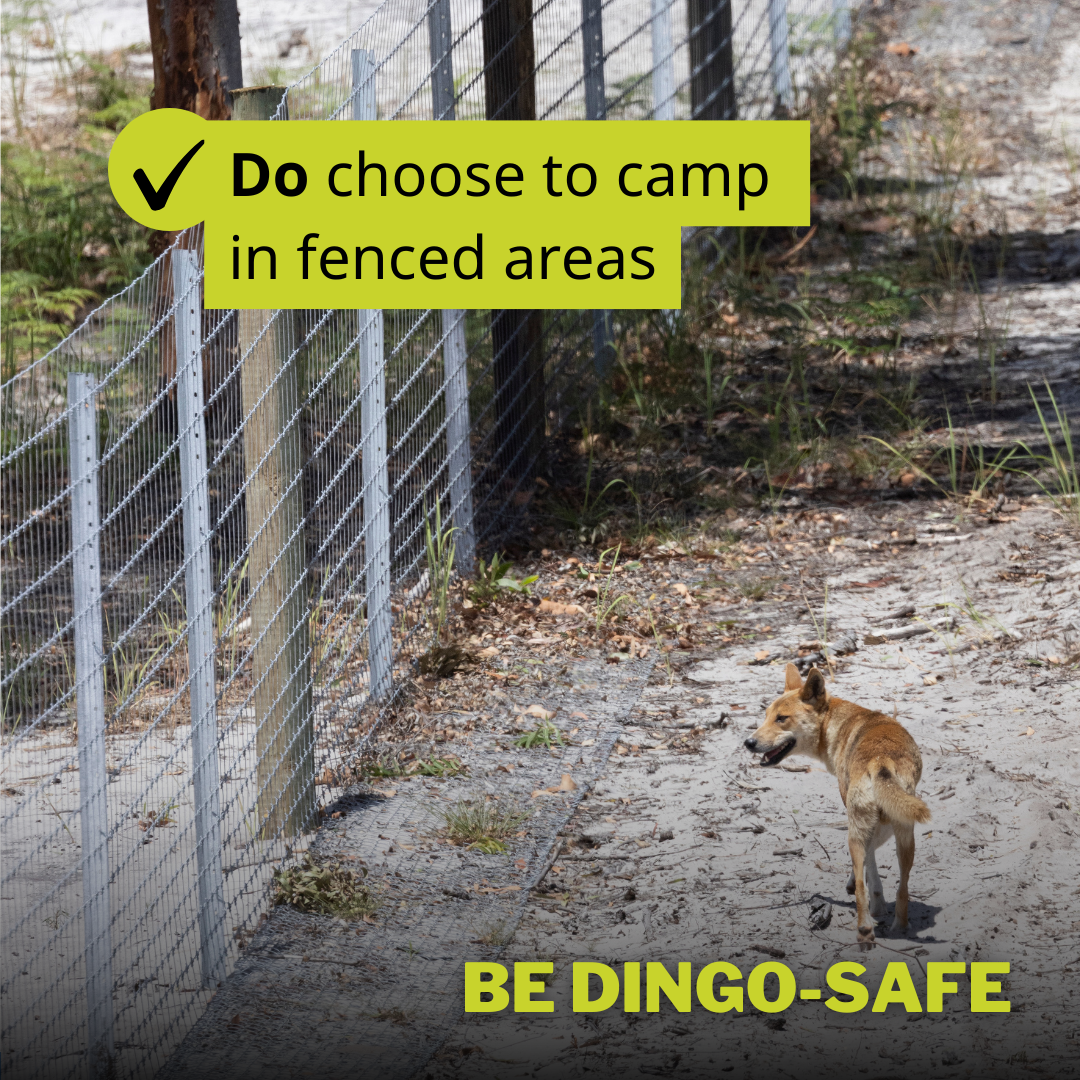
Do choose to camp in fenced areas
 Open larger image
Be dingo-safe social tile - Do choose to camp in fenced areas
Fenced camping areas, surrounded by dingo-deterrent fences, are recommended for families and groups with children 14 years and under
Always make sure you keep your campsite secure, boring and unattractive to dingoes.
Find more dingo-safe camping tips at: www.qld.gov.au/BeDingoSafe
Videos
- A series of videos on how to avoid and how to respond to a dingo interaction, and how to fish responsibly are available on our website and YouTube channels.
Other resources
Our Publications web page has a number of resources including:
- Children’s activity booklet and Dingo activity sheet .
- Be dingo-safe! guide and Be dingo-safe! quick tips sheet in English + 12 other languages.
- Tide timetables – for K’gari East and West Coast tides.
- K’gari Conditions Report – updated fortnightly with alerts, track and beach conditions, dingo warnings, and temporary closures.
- Interactive map of K'gari – a practical tool to help visitors navigate the island.
- K’gari fenced camping area map – shows fenced camping areas, recommended for families and groups with children.
- Planned Maintenance - Lake Allom Facilities 24 August to 18 September 2026
- Moon Point Road partially CLOSED K’gari (Fraser Island Recreation Area) 14 January 2026 to 30 January 2027
- Beach camping zone 9 – Diray and Carree CLOSED 20 June 2025 to 29 January 2027
- Cornwells Road partially closed, K'gari Recreation Area 12 March to 30 September 2026
- Infrastructure upgrades planned for Waddy Point and Central Station - April to November 2026 16 February to 9 November 2026
- Park Alert-Tukkee Wurroo (Indian Head) walking track temporary closure 14 June 2021 to 18 November 2026
- Wongari (Dingo) Rearing and Emergence Season 1 September to 30 November 2026
- Waddy Beach Front Camping Area: Campsite Booking Restrictions - Dingo Management 14 August to 15 December 2026
- Planned Maintenance - Lake Wabby walk 10 August to 9 November 2026
- Happy Valley Beach Access Ramp and Boardwalk Reconstruction 30 July to 14 December 2026
- Partial closure of Wanggoolba Creek Boardwalk 25 May to 26 September 2026
- Deceased Whale on Beach 22 July to 22 October 2026
- SEVERE EROSION – Inskip barge landing beach access tracks 25 March 2026 to 30 January 2027
- Ngkala Rocks to Sandy Cape Beach Conditions 20 June 2025 to 29 January 2027
- K'gari Great Walk 1 March to 31 October 2026
- Drones prohibited Lake McKenzie (Boorangoora) 21 December 2025 to 10 December 2026
- Beware crocodiles
- Be dingo-safe
- Beware marine stingers (jellyfish)
Conditions report
K'gari conditions report Updated 8 Sep 2026
Critical information for your safety is included in the conditions report—always check it before you visit.