Mangroves
The extensive river and creek estuaries within the Moreton Bay Marine Park, combined with the estuarine environment of Moreton Bay, sheltered by offshore islands, provide large areas of ideal habitat for mangroves. The largest mangrove communities are found in Pumicestone Passage and the Southern Bay Islands, south of Jacobs Well.
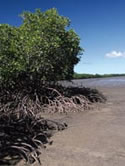
Moreton Bay Marine Park mangroves.
Studies have estimated that one hectare of mangroves provide economic benefits worth approximately $57,000 US per year. 1 This includes the value that mangroves have for fisheries, tourism and shore protection.
Queensland’s fishing and seafood sector is crucial to the state’s economy and communities, with an annual commercial catch contributing a gross value of production (GVP) of 259.2 million dollars (2022). 2 Recreational fishing is a highly valued and popular recreational pursuit in Queensland and similarly contributes 333.7 million dollars to the state’s economy annually. 3 More than 70% of commercially and recreationally caught fish and prawns depend on mangrove habitats as part of their lifecycle for nursery areas, shelter and food. 4
Decomposing leaf litter, bark, fruit and flowers from mangroves ‘kick start’ many coastal food chains. Some nutrients are used on the spot by organisms such as bacteria, fungi and crabs, while others are exported with the tides to neighbouring seagrass beds and beyond.
Mangrove forests act as coastal stabilisers. They are of particular importance as they form a protective barrier trapping sediments and stabilising shore and river edges, decreasing the threat of erosive action by waves, tidal currents and stream flow.
Mangrove forests also act as ‘net carbon sinks’ - capturing and storing carbon from the atmosphere and ocean, particularly in their sediments, at a rate of 30-50 times faster than terrestrial forests (per unit area). 5 Older stands of mangroves (17-35 years old) hold double the total carbon stocks and have double the sequestration rate of younger mangroves. 6
Human-induced damage or loss of mangroves from, for example, the impacts of climate change or coastal development, threatens the capacity of mangroves and their associated sediments to store carbon. Any disturbance to mangrove forests and their sediments results in the release of carbon and other greenhouse gases (including methane), and these emissions further contribute to climate change. 7 Therefore, it is important to preserve mangrove ecosystems, particularly stands of older mangroves, to curb greenhouse gas emissions and enable long-term storage of carbon in the sediments of these coastal ecosystems.
Mangrove communities in Moreton Bay have increased in area by nearly 11% between 1955-2021.8 Read more about the changes in extent of mangrove and associated communities of Moreton Bay.
All mangroves, dead and alive, are protected under the Fisheries Act 1994. Mangroves within the Moreton Bay Marine Park are also protected under the marine park’s zoning plan. This protection is achieved through specific zoning measures, such as green and yellow zones, which restrict and manage the physical impacts from coastal development activities. Designated go-slow areas also help protect mangrove communities by minimising potential harm from vessel wash.
There are 7 mangrove species, plus the mangrove fern Acrostichum speciosum, found in the Moreton Bay Marine Park:
- Grey mangrove (Avicennia marina)
- River mangrove (Aegiceras corniculatum)
- Smooth fruit orange mangrove (Ceriops australis)
- Long style stilt mangrove (Rhizophora stylosa)
- Large leaf orange mangrove (Bruguiera gymnorhiza)
- Milky mangrove (Excoecaria agallocha)
- White-flowered black mangrove (Lumnitzera racemosa)
In Moreton Bay Marine Park the grey mangrove dominates, with river mangroves common along river banks and the white-flowered black mangrove is at its southern limit in Moreton Bay.
Read more about mangroves.
Unusual tenants of mangroves
The Water Mouse (Xeromys myoides), a protected species9, is found within the saltmarsh and mangrove interface and has a unique nesting behaviour, constructing mud-based nests above the high tide mark. Nest structures have been observed at several locations within Moreton Bay Marine Park. This species forages at night between low and high tides feeding on intertidal crustaceans, marine flatworms, marine snails and slugs, and marine bivalves.
Read more about the National Recovery Plan for the Water Mouse.
References and further reading
- UNEP (2014). The Importance of Mangroves to People: A Call to Action. van Bochove, J., Sullivan, E., Nakamura, T. (Eds). United Nations Environment Programme World Conservation Monitoring Centre, Cambridge. 128 pp
- Microsoft Power BI
- BDO (2021). Economic contribution of recreational fishing by Queenslanders to Queensland – A report to Fisheries Queensland. Department of Primary Industries.
- Department of Environment and Science, Queensland (2019). Mangrove uses. WetlandInfo https://wetlandinfo.des.qld.gov.au/wetlands/ecology/components/biota/flora/flora-structural/mangroves/mangrove-use.html
- Costa, M.D.P.C., Lovelock, C., Waltham, N. and Macreadie, P.I. (2020). Blue Carbon Opportunities in Queensland: how much and where?. A report provided to the Land Restoration Fund, Queensland Government. Deakin University, Melbourne, 34pp.
- Carnell, P.E., Palacios, M.M., Waryszak, P., Trevathan-Tackett, S.M., Masque, P., and Macreadie, P.I. (2022). Blue carbon drawdown by restored mangrove forests improves with age. Journal of Environmental Management, 306. 114301. https://doi.org/10.1016/j.jenvman.2021.114301
- Ollivier, Q.R., Maher, D.T., Pitfield, C. and Macreadie, P.I. (2022). Net Drawdown of Greenhouse Gases (CO2, CH4 and N2O) by a Temperate Australian Seagrass Meadow. Estuaries and Coasts, https://doi.org/10.1007/s12237-022-01068-8.
- Department of Environment, Science and Innovation, Queensland (2024). Mangroves and associated communities of Moreton Bay, WetlandInfo website, accessed 20 August 2025. Available at: https://wetlandinfo.des.qld.gov.au/wetlands/ecology/components/biota/flora/flora-structural/mangroves/mangrove-moreton.html
- EPBC Act 1999 Conservation Advice for Xeromys myoides (Water Mouse) https://www.environment.gov.au/biodiversity/threatened/species/pubs/66-conservation-advice-29092021.pdf
- Lovelock, C. E., Accad, A., Dowling, R. M., Duke, N. and Yip, S. (2019). Mangroves and saltmarshes of Moreton Bay. Moreton Bay Quandamooka & Catchment, 299.
Mangroves are an essential part of the marine park's ecosystem, providing food and shelter for a variety of species.
- There are currently no park alerts for this park.
Get the app!
Zone and designated area information for the Moreton Bay Marine Park and Great Sandy Marine Park.
