Whales
Whales (and dolphins) are also known by their scientific name: cetaceans. Cetaceans are warm blooded mammals that spend their entire life in the water. They are characterised by the use of a blowhole on the top of their head for breathing and their long life spans.
Moreton Bay Marine Park is renowned for its high diversity and abundance of cetaceans, making it one of the most significant marine habitats in Australia. 1 The iconic humpback whales are a seasonal highlight, visiting the marine park between June and October each year while other whales, such as southern right whales (Eubalaena australis), sperm whales (Physeter macrocephalus), and minke whales (Balaenoptera acutorostrata), are occasional visitors to the region.
Globally, whales face challenges from habitat degradation, pollution, boat traffic, and climate change. Entanglement in nets, vessel strikes and disturbance by people are some of the threats facing whales in Moreton Bay Marine Park. Conservation efforts in the marine park and public awareness campaigns, aim to protect the vital ecosystems and marine life in Moreton Bay, ensuring the marine park remains an important habitat for whales and a key area for research and observation.
Whales in the marine park
Nine species of whale visit Moreton Bay Marine Park each year and it is one of the northern most places in Australia for sightings of the Southern Right whale. The migratory behaviour of whales and their behaviour of congregating in breeding areas make them susceptible to disturbance by boats. Even the noise from nearby outboard engines can be enough to disrupt their social behaviours and cause unnecessary stress. With increasing numbers of whales migrating into Queensland each winter and with increasing boating traffic, there is an increased risk of collisions between boats and whales.
Humpback whales (Megaptera novaeangliae)
Humpback whales (Megaptera novaeangliae) are regular seasonal visitors to the marine park. As the fifth-largest of the great whales, adult females can grow up to 15 metres in length, slightly larger than males, and weigh up to 45 tonnes. These whales are characterised by their blackish colouring with white underbellies and sides.
Humpbacks mate and give birth in warmer waters. Each year the east Australian humpback whale population migrates 6000km, from their Antarctic feeding grounds, along the eastern coastline of Australia, to arrive in the Great Barrier Reef in about mid-June for breeding and calving. From July, after calving, the humpbacks start to migrate south—back to the Antarctic waters. A proportion of the population stops over in Moreton Bay. Most humpbacks have left Queensland waters by early November.
Humpbacks are well known for their acrobatic displays such as leaping, rolling and breaching, which provide breathtaking viewing for whale watchers. They are also known for their complex "songs," which are particularly prominent during the breeding season.
Since the global ban on commercial whaling, humpback whale populations have shown remarkable recovery, leading to their removal from Commonwealth and state threatened species lists. However, their continued recovery depends on successful reproduction and the minimisation of human impacts throughout their migration. The waters of Moreton Bay Marine Park offshore from the large sand islands provide an important migratory corridor for their journey between Antarctic feeding grounds and Queensland’s warmer waters, where they breed and give birth between June and October. Notably, Migaloo, one of the world’s few all-white humpback whales, has been sighted travelling through Moreton Bay Marine Park, adding to the region’s significance as a whale migration corridor.
As of 2024, the east coast population of humpback whales, which migrates along Australia's eastern seaboard, is estimated to be around 50,000 individuals. 2, 3
Other whales in Moreton Bay Marine Park
In addition to humpback whales, Moreton Bay Marine Park is visited by a variety of other cetacean species throughout the year. These include:
- Southern right whales (Eubalaena australis): occasionally sighted during their east coast migration.
- Sperm whales (Physeter macrocephalus): typically found in deeper offshore waters but occasionally venture closer.
- Minke whales (Balaenoptera acutorostrata): occasionally seen in the region, particularly during migration.
Read more about whales and watching marine mammals.
Protection
Both state and Commonwealth legislation contribute to the protection of whales.
At the state level, the Nature Conservation Act 1992 and the Marine Parks Act 2004 provide the legal framework for safeguarding marine mammals and their habitats. The state government plays a critical role in the protection of whales and is responsible for managing cetacean conservation within coastal waters. This includes responding to stranded or entangled whales and dolphins, regulating whale-watching activities, and enforcing marine park zoning regulations. The Queensland Parks and Wildlife Service (QPWS) leads these efforts, and works closely with First Nations groups, local communities, researchers, and other stakeholders to ensure the effective management of cetacean populations.
These state laws align with the Commonwealth’s Environment Protection and Biodiversity Conservation Act 1999 (EPBC Act). Humpback whales are listed as a migratory species under the EPBC Act, which also establishes the Australian Whale Sanctuary and offers high-level protection to cetaceans, including whales and dolphins, within Commonwealth waters.
References and further reading
- Chilvers, B.L., Lawler, I.R., Macknight, F., Marsh, H., Noad, M. and Paterson, R. (2005). Moreton Bay, Queensland, Australia: an example of the co-existence of significant marine mammal populations and large-scale coastal development. Biological Conservation, 122, 559-571.
- Smith, B. (2025). Eastern Australian humpback whale population now well above pre-whaling levels, report finds. ABC Lab Notes. https://www.abc.net.au/news/science/2025-10-07/humpback-whales-eastern-population-numbers-rebound-estimate/105843256, accessed 8 October 2025.
- Noad, M., Kniest, E. & Dunlop, R. (2019). Boom to bust? Implications for the continued rapid growth of the eastern Australian humpback whale population despite recovery. Population Ecology, 61, 198–209. https://doi.org/10.1002/1438-390X.1014 (2019).
Bejder, M., Johnston, D. W., Smith, J., Friedlaender, A. and Bejder, L. (2015). Embracing conservation success of recovering humpback whale populations: Evaluating the case for downlisting their conservation status in Australia. Marine Policy, 66, 137-141.
Castrillon, J., Mayaud, R., Wilson, C., Dalle Luche, G., Allen, J. and Bengston Nash, S. (2023). Moreton Bay; A previously unrecognised resting stopover for east-coast of Australia migrating humpback whales. Frontiers in Marine Science, 10:1063197.
Mayaud, R., Smith, J.N., Peel, D., Wilson, C., Franklin, W., Stevens, T. and Nash, S.B. (2025). Differences in the functional use of two migratory stopovers by humpback whales (Megaptera novaeangliae). PLoS One 20(5): e0321010. https://doi.org/10.1371/journal.pone.0321010
Noad, M.J., Dunlop, R.A., Paton, D. and Kniest, H. (2021). Abundance estimates of the east Australian humpback whale population. International Whaling Commission (IWC) Working Paper.
Noad, M. J., Dunlop, R. A., & Paton, D. (2022). A mammalian messenger RNA sex determination method from humpback whale (Megaptera novaeangliae) blubber biopsies. Royal Society Open Science, 9(9), 220556.
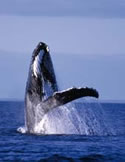
Humpback whale breaching, Moreton Bay Marine Park.
Moreton Bay Marine Park has the highest recorded diversity and abundance of resident and transient cetaceans in Australia.
- There are currently no park alerts for this park.
Get the app!
Zone and designated area information for the Moreton Bay Marine Park and Great Sandy Marine Park.
