Shorebirds
Shorebirds, also known as waders, are a diverse group of birds commonly seen feeding in intertidal areas or on the fringes of freshwater wetlands. They generally have long legs in relation to their body size, no webbing on their feet and they do not swim. The shape and size of their bill gives a clue to their preferred diet and habitat. The long probing bill of the far eastern curlew Numenius madagascariensis is ideal for fishing out worms and crustaceans from deep mud whereas the short, stubby bill of the ruddy turnstone can flip aside stones and shells on a rocky foreshore to expose food.
Shorebirds make up about ten percent of Australia's species of birds. Most breed in the Northern Hemisphere and every year (September to April) around 34,000 migratory shorebirds travel to the Moreton Bay Marine Park. 1 Twenty-seven migratory species rely on habitats in the marine park, including far eastern curlews Numenius madagascariensis, grey-tailed tattlers Heteroscelus brevipes, red-necked stints Calidris ruficollis, ruddy turnstones Arenaria interpres, bar-tailed godwits Limosa lapponica and sandpipers.
Migratory shorebirds
Most of the shorebird species that visit Moreton Bay Marine Park's intertidal flats are migratory species listed under the Japan Australia Migratory Bird Agreement (JAMBA) or the China Australia Migratory Bird Agreement (CAMBA).
Australia has agreed to protect shorebirds and their habitats under several international treaties that protect migratory waders. Most notably the wetlands within Moreton Bay Marine Park are recognised under the Ramsar Convention—an international treaty that provides for the protection of wetlands of international significance. Furthermore, all migratory shorebirds are protected as ‘migratory species’ under the Commonwealth Environmental Protection and Biodiversity Conservation Act 1999.
Most migrate from Arctic or sub-Arctic regions at the end of the breeding season, moving to the southern hemisphere and stopping to rest before the next stage of their long journey. When feeding here, migratory shorebirds are storing energy for their return trip north to breed again.
The migratory shorebirds prefer four main habitats—muddy intertidal flats with and without seagrass, sandy flats and coral rubble on islands in the middle of the bay. Mirapool sandflat, in the south-east of Moreton Island, is considered a vital roosting and feeding site for shorebirds, particularly far eastern curlews.
Major roosting and feeding sites for shorebirds include open sandy islands and beaches (mainly on Moreton Island and North Stradbroke Island), saltpans and claypans scattered in and behind the mangrove fringe, freshwater marshes and mangroves.
Shorebirds fly through extreme weather, avoiding predators as they navigate a chain of wetlands from the northern to southern hemispheres. Moreton Bay Marine Park is an important habitat in the East Asian-Australasian Flyway, which is one of only eight international routes taken by migratory birds. The marine park is often the first site shorebirds use in Australia on their southern journey and the last site before they return north.
Shorebirds travel remarkable distances of up to 25,000 kilometres each year. They breed in areas where melting snow brings masses of insects, providing a vital food source for self-feeding chicks. Once breeding is complete, and before the onset of the arctic winter, the adults and their chicks begin their return journey to the plentiful feeding grounds in the south.
Migrating shorebirds need huge amounts of energy to complete their journey. One of the best-studied species, the far eastern curlew, dramatically builds up its body weight just prior to migration. During its 13,000 kilometre flight from Siberia to Australia it will burn 40 percent of its body weight. This is equivalent to an 80-kilogram person running 16 million kilometres almost non-stop and losing 32 kilograms, twice a year!
Each year, around 15 percent of the migrating shorebirds that visit Moreton Bay Marine Park in the summer remain for the whole year. This includes birds that are too young to breed or adults that are too weak for the northern journey.
Resident shorebirds
Moreton Bay Marine Park supports 12 different species of non-migratory shorebirds. Several thousand resident shorebirds have been known to breed in and around the marine park. 2 Some of the most recognisable species include the pied oystercatcher, the bush stone-curlew and the red-capped plover. The vulnerable beach stone-curlew is less common and of international and national significance because ongoing disturbance has drastically reduced their numbers.
When it is time for resident shorebirds to breed, they build their nests just above the high tide line of beaches and rocky shorelines. This exposes them to damage from vehicles driving above high tide lines and from people camping on dunes. Each year many young shorebirds and some adults are killed because of beach traffic.
Shorebirds' lives are driven by the tides
At low tide, regardless of day or night, shorebirds feed constantly - pecking and probing for worms, insects and crustaceans. With their highly variable and specialised bills they feed around intertidal flats, beaches, rocky headlands and along the fringes of freshwater wetlands.
As the incoming tide covers these feeding areas, they begin to congregate in large numbers at relatively safe roost sites nearby. These roost sites provide areas where they can interact, preen, digest their food and rest while waiting for the ebbing tide to again expose their feeding areas. During particularly high spring tides, the shorebirds of Moreton Bay Marine Park crowd together on a limited number of higher elevation roost sites. Any disturbance during this time has major consequences - shorebirds may even be forced to abandon their roost sites because of disturbances.
Major roosting and feeding sites for shorebirds in Moreton Bay include:
- Caloundra sandbanks
- north Bribie Island
- Toorbul north and south
- Kakadu beach, Bribie Island
- Nudgee beach
- Port of Brisbane
- Deception Bay
- Mirapool Beach, south eastern end of Moreton Island
- Reeders Point, south western end of Moreton Island
- Amity sandbank
- Goat Island
- Manly Harbour
- Queens Esplanade, Thorneside
- Swan Bay, North Stradbroke Island
- Horseshoe Bay, South Stradbroke Island
- Geoff Skinner Reserve
- King Street Thornlands
- Coombabah Wetlands
You can help protect shorebirds
Shorebirds are very easily disturbed by activities that occur at some distance away. A disturbance is any action that interrupts the breeding, feeding or resting of shorebirds. For example, causing a shorebird to take flight represents a significant disturbance. When shorebirds take flight they use critical energy that is required for migration and breeding. Repeated disturbances and disturbances that occur before or after migration are particularly damaging for shorebirds. Without sufficient energy reserves shorebirds may be unable to complete their migration or breed. You can avoid disturbing shorebirds by looking out for them and giving them plenty of space to rest and feed.
Dogs, in particular, disturb shorebirds. In local government areas adjoining Moreton Bay Marine Park dogs must be on a leash at all times except in designated "off leash" areas. Dogs are also not permitted on beaches adjacent to a National Park such as Gheebullum Kunungai (Moreton Island) or Bribie Island. Penalties apply for failing to comply with this requirement. Penalties also apply to individuals who cause unreasonable disturbance to shorebirds anywhere in the Marine Park.
References and further reading
- Fuller, R.A., Milton, D.A., Rothlisberg, P., Clemens, R.S., Coleman, J., Murray, K., Dhanjal-Adams, K.L., Edwards, D., Finn, P. G., Skilleter, G., Stigner, M. and Woodworth, B.K. (2019). Migratory shorebirds of Moreton Bay. In: Tibbetts IR, Rothlisberg PC, Neil DT, Homburg TA, Brewer DT, & Arthington AH (Eds). Moreton Bay Quandamooka & Catchment: Past, present, and future. The Moreton Bay Foundation. Brisbane, Australia. Available from: https://moretonbayfoundation.org/
- Driscoll, P.V. (1997). The distribution of waders along the Queensland coastline. Pp. 80–123. In: Straw, P. (ed.). Shorebird conservation in the Asia-Pacific region. Aust. Wader Study Group, Melbourne.
Clemens, R.S., Rogers, D.I., Hansen, B.D., Gosbell, K., Minton, C.D.T., Straw, P., Bamford, M., Woehler, E.J., Milton, D.A., Weston, M.A., Venables, B., Weller, D., Hassell, C., Rutherford, B., Onton, K., Herrod, A., Studds, C.E., Choi, C.Y., Dhanjal-Adams, K.L., Murray, N.J., Skilleter, G.A., and Fuller, R.A. (2016). Continental-scale decreases in shorebird populations in Australia. Emu, 116: 119-135.
Fuller, R.A., Clemens, R.S., Woodworth, B.K., Moffitt, D. and Simmons, B.A. (2021). Managing Threats to Migratory Shorebirds in Moreton Bay. Final report to Healthy Land and Water. University of Queensland, Brisbane.
QPWS (2005). Shorebird management strategy - Moreton Bay, Environmental
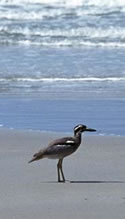
Beach curlew, Moreton Bay Marine Park.
Shorebirds fly up to 25,000 kilometres on their annual trip to Moreton Bay Marine Park.
- There are currently no park alerts for this park.
Get the app!
Zone and designated area information for the Moreton Bay Marine Park and Great Sandy Marine Park.
