Saltmarsh
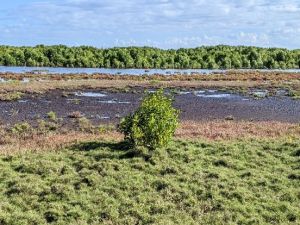
Saltmarsh at Hays Inlet
Photo credit: © Dirk van Kampen
Saltmarsh is an intertidal community often only intermittently inundated by the highest spring tides, consisting of salt tolerant plants such as sedges, rushes, reeds, grasses, low shrubs and succulent herbs. The Subtropical and Temperate Coastal Saltmarsh community is listed as ‘vulnerable’ under the Commonwealth Environment Protection and Biodiversity Conservation Act 1999. In Queensland this includes all saltmarsh communities south of Gladstone.
In the Moreton Bay Marine Park, saltmarsh is often found in the upper intertidal area between the mangrove fringe and the terrestrial vegetation, including for example near Redcliffe Peninsula, Deception Bay and Pumicestone Passage. Saltmarsh grows in harsh environmental conditions and tolerates daily fluctuations in salinity, water level, temperature, soil aeration, sunlight and moisture. Saltmarsh can be interspersed with unvegetated areas called claypans or saltpans.
Saltmarsh acts as a ‘net carbon sink’ - capturing and storing carbon from the atmosphere and ocean, particularly in sediments, at a rate of 30-50 times faster than terrestrial forests (per unit area)1. Human-induced damage or loss of saltmarsh from, for example, the impacts of climate change or coastal development, threatens the capacity of saltmarsh and their associated sediments to store carbon. Any disturbance to saltmarsh results in the release of carbon and other greenhouse gases (including methane), and these emissions contribute to climate change2. Therefore, it is important to preserve areas of saltmarsh to curb greenhouse gas emissions and enable the long-term storage of carbon in the sediments of these coastal ecosystems. The marine park’s green and yellow zones protect saltmarsh areas from the physical impacts from coastal development activities.
Read more about the changes in extent of mangrove and associated communities of Moreton Bay.
Read more about saltmarsh.
Unusual and rare tenants of saltmarsh
The Water Mouse (Xeromys myoides), a protected species under Commonwealth and State legislation 3, 4, can be found where saltmarsh adjoins mangrove forests. It has a unique nesting behaviour, constructing mud-based nests in suitable habitat above the elevated high tide mark. Nest structures have been observed at several locations within Moreton Bay Marine Park. This species forages at night between low and high tides feeding on intertidal crustaceans, marine flatworms, snails, slugs, and bivalves.
Read more about the National Recovery Plan for the Water Mouse.
References and further reading
- Costa, M.D.P.C., Lovelock, C., Waltham, N. and Macreadie, P.I. (2020). Blue Carbon Opportunities in Queensland: how much and where?. A report provided to the Land Restoration Fund, Queensland Government. Deakin University, Melbourne, 34pp.
- Ollivier, Q.R., Maher, D.T., Pitfield, C., and Macreadie, P.I. (2022). Net Drawdown of Greenhouse Gases (CO2, CH4 and N2O) by a Temperate Australian Seagrass Meadow. Estuaries and Coasts, https://doi.org/10.1007/s12237-022-01068-8.
- EPBC Act 1999 Conservation Advice for Xeromys myoides (Water Mouse)https://www.environment.gov.au/biodiversity/threatened/species/pubs/66-conservation-advice-29092021.pdf
- Nature Conservation (Animals) Regulation 2020 https://www.legislation.qld.gov.au/view/html/inforce/current/sl-2020-0136
Johns, L. (2019). Field guide to common saltmarsh plants of Queensland, Queensland Government.
- There are currently no park alerts for this park.